
Arc is Circle’s attempt to turn stablecoin issuance into a complete financial stack: an EVM-compatible chain built around predictable USDC fees, institutional settlement, embedded FX, selective privacy, and eventually decentralized security.
+92 sources across the wider coverage universe
 Circle exploring native Arc token for governance and incentives, targeting eventual proof-of-stake transition2026-04
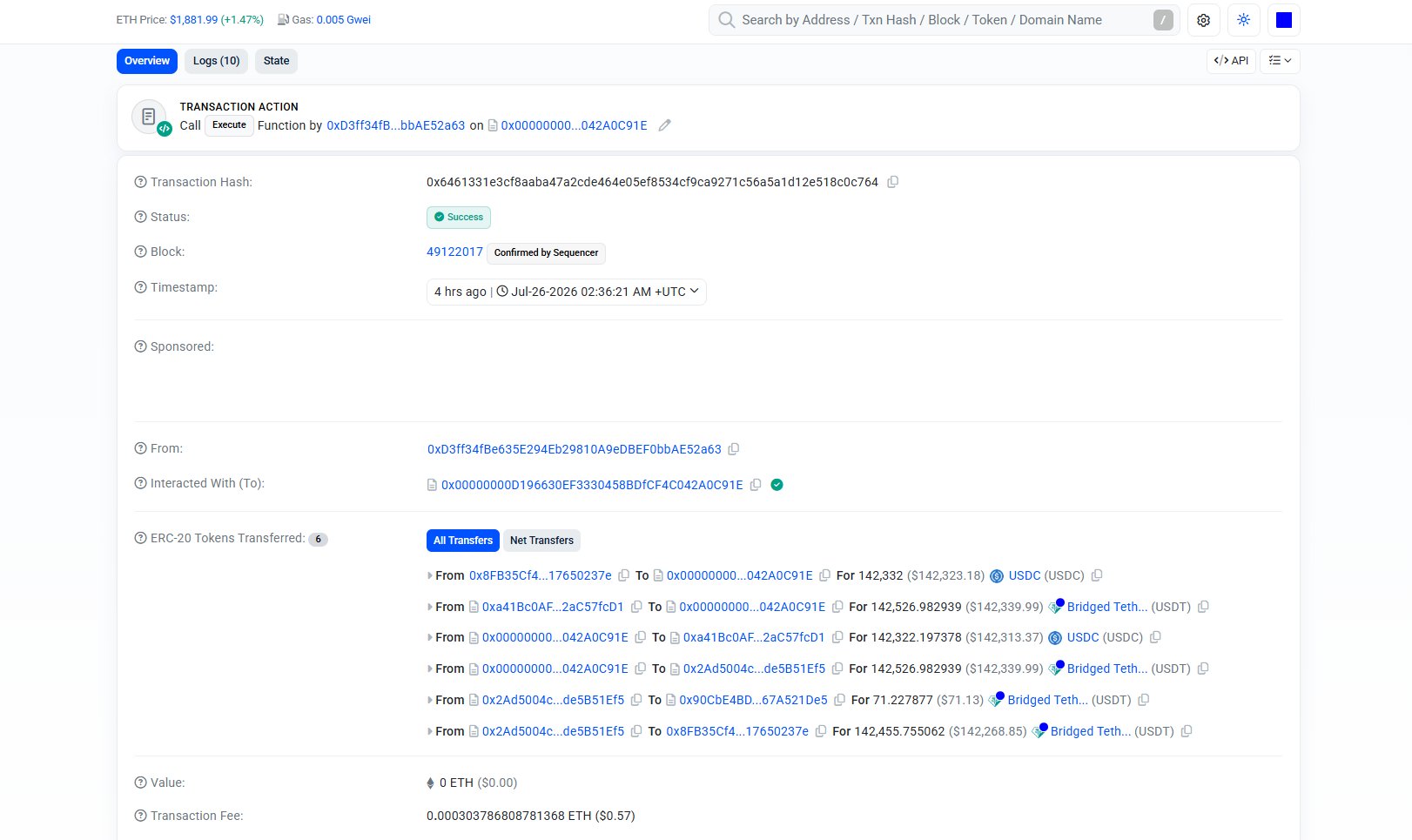 Unofficial Arc bridge lets anonymous owner sweep $490K USDC reserve from unverified vault2026-07
 Circle's Arc joins Chainlink Scale with CCIP, Data Streams, Data Feeds, and Proof of Reserve2026-07
 Arc launches open-source stablecoin FX app on testnet, pitching a flagship multi-currency hub for global stablecoin finance2026-06
 Circle announced that cirBTC, a 1:1 BTC-backed wrapped bitcoin token, is now live on Ethereum, bringing secure and neutral collateral to DeFi markets with planned Arc and multichain support for institutional users.2026-06
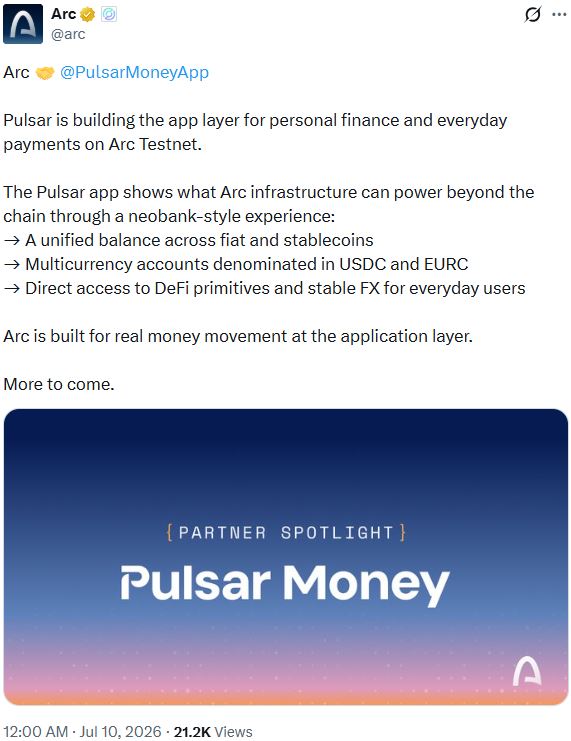 Pulsar launches a neobank-style personal finance app on Arc Testnet with fiat and stablecoin support2026-07
Arc: Circle’s Stablecoin-Native Layer‑1 Explained
Arc is a public, EVM-compatible layer‑1 blockchain developed by Circle and purpose-built for stablecoin finance. Circle describes it as an economic operating system for digital dollars, global payments, foreign exchange, credit, and capital markets. The more useful classification is narrower: Arc is an attempt to make the stablecoin issuer part of the settlement infrastructure beneath the stablecoin.
Instead of centering the user experience on a volatile native gas token, Arc uses USDC as the fee asset and treats fiat-backed stablecoins as first-class monetary instruments. The intended gain is predictable, dollar-denominated execution for institutions and ordinary users; the corresponding cost is a network whose monetary plumbing, early governance, and commercial incentives are unusually close to one company.
Arc combines several ideas that are normally scattered across separate blockchains and applications: deterministic sub-second finality through the Malachite consensus engine, USDC-denominated gas, an integrated foreign-exchange mechanism, opt-in transaction privacy, structured payment metadata, EVM-compatible execution, and connections to Circle’s payments and cross-chain products. A separate ARC token is intended to coordinate governance, validator incentives, and an eventual transition from proof of authority to proof of stake.
The resulting proposition is not simply that Arc can process stablecoin transfers. Ethereum, Base, Solana, Polygon, and other networks already do that. Arc’s proposition is that a chain designed around the operational requirements of stablecoin finance can make payments, currency conversion, reconciliation, credit, and tokenized-asset settlement feel like parts of one system rather than independent applications joined after the fact.
That integration creates the central question running through Arc’s design. The same control that lets Circle coordinate fees, validators, privacy, cross-chain movement, and institutional integrations can make the network easier to operate and regulate. It can also concentrate technical, commercial, and censorship power. Arc is therefore best understood as a test of whether institutionally managed blockchain infrastructure can preserve enough openness and composability to remain meaningfully public.
Origins: Circle, USDC, and the Rationale for Arc
Arc cannot be understood separately from Circle’s evolution and the rise of USDC. Circle began as a consumer-facing crypto company before moving toward regulated financial infrastructure. USDC became the center of that transition: a fiat-backed token designed to remain redeemable for one U.S. dollar and to function across exchanges, decentralized finance, payments, and treasury systems.
As USDC expanded across multiple networks, Circle’s role broadened. The company was no longer merely creating tokens. It was operating reserve, issuance, redemption, wallet, API, treasury, and cross-chain systems that connected conventional banking to public blockchains. Arc extends that progression downward into consensus and blockspace. Circle is attempting to own more of the route between a bank balance, a stablecoin, an application, and final onchain settlement.
This is a vertical-integration strategy expressed as blockchain architecture. A payment moving through Arc can potentially touch Circle-controlled or Circle-integrated services at several layers: fiat access, stablecoin issuance, wallet infrastructure, cross-chain transfer, gas payment, and base-layer settlement. That can reduce coordination costs, but it also means that evaluating Arc requires evaluating the entire stack rather than benchmark figures for the chain alone.
Circle, USDC, and the evolution of stablecoins
USDC is designed to be redeemable for one U.S. dollar and backed by cash and short-dated U.S. government obligations held through regulated financial institutions. Circle has emphasized reserve reporting and regulatory alignment as distinguishing features. That posture matters because the economic value of a fiat-backed stablecoin depends on more than the smart contract: holders must trust the reserves, redemption process, banking relationships, and legal structure behind it.
Stablecoins occupy two financial worlds at once. On centralized exchanges, they function as quote currencies, settlement assets, and collateral. In decentralized finance, they serve as the primary unit for lending, automated market making, leverage, and derivatives margin. In payments, they promise continuous settlement without requiring every participant to share a bank or domestic clearing system.
These roles impose different requirements. Trading rewards speed and deep liquidity. Merchant payments need low, predictable costs and refund or authorization logic. Institutional settlement requires clear finality, operational controls, auditability, and systems that can communicate with existing accounting and compliance software. Stablecoin infrastructure therefore cannot be judged solely by transactions per second. It must be judged by whether money can enter, move, change currency, acquire context, and exit reliably.
Circle has also developed euro-denominated EURC and tokenized cash-equivalent products such as USYC. The strategic direction is broader than distributing one dollar token. Circle is assembling a portfolio of programmable monetary instruments and the services around them. Arc provides a common environment in which those instruments can interact under design assumptions chosen specifically for financial activity.
Coinbase has played an important role in USDC’s distribution through its exchange, wallet products, and early partnership with Circle. Coinbase’s Base network has also become a major venue for stablecoin-heavy applications. Arc does not erase that relationship or make other USDC networks irrelevant. It gives Circle a settlement layer it controls more directly while USDC continues to circulate elsewhere.
That distinction matters. Arc is not best read as a demand that liquidity migrate from every existing chain. It is a bid to create a preferred venue for workflows in which Circle’s issuance, payments, foreign-exchange, privacy, and institutional infrastructure are more valuable when deployed together.
Why general-purpose blockchains are an awkward fit
General-purpose blockchains were not originally designed around fiat-backed stablecoins as their dominant economic unit. Their fee markets usually depend on a volatile native asset. A user sending USDC on Ethereum, for example, needs ETH for gas. Similar arrangements exist on many other layer‑1 and layer‑2 networks.
For a crypto trader, maintaining a gas balance may be routine. For a business pricing goods, payroll, or treasury operations in dollars, it creates a separate asset-management problem. The company must acquire and monitor an unrelated token simply to move its dollar-denominated balance. Gas abstraction can conceal that requirement, but someone in the system still bears the token exposure and conversion risk.
Using USDC for fees translates blockchain execution into a familiar business expense. It is analogous to a card processor billing a merchant in the same currency as the sale instead of requiring the merchant to maintain a fluctuating inventory of processor shares. The benefit is intelligible budgeting and a simpler interface. The trade-off is that Arc’s fee economy becomes dependent on USDC’s availability, stability, and issuer-managed infrastructure.
General-purpose chains also leave foreign exchange mostly to applications. Currency conversion emerges through automated market makers, order books, aggregators, and market makers operating above the protocol. That openness produces competition and experimentation, but it can fragment liquidity and force payment applications to assemble execution guarantees from several independent systems.
Arc’s design treats currency conversion as core financial infrastructure. An integrated request-for-quote mechanism and payment-versus-payment settlement are meant to let counterparties exchange supported stablecoins without treating FX as an incidental token swap. This reclassifies stablecoin exchange from a DeFi feature into a settlement primitive.
Privacy presents a similar mismatch. Fully transparent ledgers reveal more commercial information than many institutions are willing to expose, while private ledgers sacrifice public composability and shared state. Regulated finance often needs selective confidentiality: transaction details may need to be hidden from competitors but available to authorized counterparties, auditors, or regulators. Arc’s opt-in approach attempts to occupy that middle ground.
No technical feature eliminates the underlying governance question. Selective visibility requires rules and infrastructure determining who can see what, while a built-in FX venue raises questions about access and market structure. Arc’s value will depend not only on whether these systems work but on whether their control surfaces remain predictable and contestable.
The multichain problem Circle is trying to solve
Supporting USDC across many networks gives Circle distribution and reduces reliance on any one chain. It also creates operational heterogeneity. Each network has different finality assumptions, fee assets, bridge risks, wallet behavior, congestion patterns, smart-contract environments, and governance arrangements.
For a user, the token symbol may look the same everywhere. For an institution moving substantial value, USDC on one chain is not operationally identical to USDC on another. The institution must evaluate which version is native, how redemption works, how quickly a transfer becomes irreversible, whether cross-chain movement depends on a bridge, and what happens during congestion or an exploit.
Arc is an attempt to standardize more of that environment under Circle’s influence. Circle can tune the network around its own assets and connect it directly to issuance, redemption, payments, wallets, and cross-chain movement. The upside is fewer seams between products. The downside is that failures or policy changes within the Circle stack can affect more layers of the transaction path at once.
This makes Arc complementary to multichain USDC in distribution but competitive in settlement importance. USDC can remain available broadly while Arc becomes the venue Circle prefers for workflows requiring the deepest integration with its services. The observable test is not whether Circle continues supporting other chains; it is whether pricing, product capabilities, liquidity, or institutional integrations make Arc materially more attractive than those alternatives.
An economic operating system, translated
Calling Arc an economic operating system is ambitious branding, but the analogy clarifies the intended role. An operating system supplies common services so every application does not have to rebuild storage, permissions, networking, and process management. Arc aims to supply monetary equivalents: settlement, fees, currency exchange, confidentiality options, structured transaction context, token issuance, and cross-chain connectivity.
The chain is intended to support programmable money, tokenized assets, credit, and institutional markets in one EVM-compatible environment. Developers can use familiar Solidity tools, while financial applications can rely on infrastructure designed around stable-value assets rather than adapting every workflow to a speculative native currency.
The benefit of this integrated approach is coherence. A payment application can potentially quote FX, pay gas, settle, attach reconciliation data, and transfer liquidity across chains without assembling a different provider for each step. The cost is platform dependence. When the operating system and a major currency running on it share a corporate sponsor, neutrality cannot be assumed from technical openness alone.
Circle has presented Arc as open and aligned with a multichain ecosystem. That claim should be tested through behavior: whether independent developers can deploy without discretionary approval, whether assets and applications can leave through reliable interoperability routes, whether validator participation broadens, and whether competing stablecoins receive treatment comparable to Circle’s own products.

Zerion API to support Arc mainnet from day one with interpreted balances, prices and transactions

Architecture and Core Features
Arc combines high-performance consensus, EVM-compatible execution, stablecoin-denominated fees, financial market infrastructure, optional privacy, structured metadata, and a long-term cryptographic migration plan. Each component addresses a real limitation in existing blockchain finance. Their combination, however, makes Arc more complex than a simple payments chain and expands the number of systems that must work correctly together.
Consensus, finality, and the early trust model
At the center of Arc is Malachite, a Byzantine Fault Tolerant consensus engine designed for deterministic sub-second finality. Deterministic finality means that once the network finalizes a transaction, participants do not need to wait for additional blocks merely to reduce the probability of reversal. That property is particularly useful for payments, exchange, and delivery-versus-payment settlement, where uncertainty about completion can force intermediaries to maintain buffers or delay downstream actions.
Circle has publicly discussed a target of roughly 350 milliseconds for transaction finality and approximately 3,000 transactions per second during the network’s early period. The useful comparison is not simply another chain’s maximum laboratory throughput. For financial applications, the consequence of fast deterministic finality is that a recipient, market maker, or smart contract can treat a transfer as complete on a human-imperceptible timescale.
Arc initially relies on proof of authority, with a limited group of known institutions operating validators under Circle’s selection and oversight. This structure can deliver consistent performance because validators are professionally operated and identifiable. It can also simplify incident response and give institutions an accountable counterparty.
Those advantages are inseparable from the costs. A small, vetted validator set is easier to coordinate, regulate, pressure, or interrupt than a widely distributed permissionless network. Arc’s early security rests substantially on organizational reputation, legal agreements, operational competence, and Circle’s validator governance. That is closer to a shared institutional network than to a censorship-resistant public commodity.
The distinction should not be obscured by the fact that anyone may be able to submit transactions or deploy contracts. Public access and decentralized control are separate properties. A network can expose an open interface while final ordering and governance remain concentrated.
The eventual transition to proof of stake is intended to change that balance. ARC would become the economic collateral posted by validators and delegators, replacing identity-based authority with stake-based incentives. Yet proof of stake is not automatically decentralized. Distribution depends on token ownership, validator requirements, delegation behavior, client diversity, geography, and governance rules.
The relevant test is therefore not the label attached to the future consensus mechanism. It is whether independent operators can enter the validator set, whether Circle can remove or override them, how concentrated delegated stake becomes, and whether governance power disperses beyond Circle and early capital providers.
USDC as gas
Arc’s most immediately legible feature is its use of USDC for transaction fees. Users can hold and spend the same asset for payment value and network execution rather than maintaining a separate native token balance. That simplifies wallet design and makes costs easier to express in accounting systems.
For consumer applications, the benefit is reduced cognitive friction. A user receiving ten dollars does not need to discover that the balance is immovable until a different token arrives. For businesses, the benefit is budgetability: fees can be forecast in a dollar unit rather than translated continuously from a fluctuating cryptoasset.
The design does not make fees inherently low or perfectly stable. USDC stabilizes the denomination, not the demand for blockspace. If network use rises sharply, transaction prices could still increase in dollar terms. Arc must therefore demonstrate both predictable fee mechanics and adequate capacity.
Using a stablecoin for gas also separates the transaction currency from the network’s coordination asset. USDC handles payments and execution costs; ARC is intended for governance, staking, and incentives. This resembles a country in which the currency used by households is distinct from the membership shares used to govern a clearing utility.
The separation can shield ordinary users from ARC volatility. It may also weaken the direct relationship between network demand and the token if ARC holders do not capture fees or other economic value in a durable way. ARC’s value proposition consequently depends on the detailed staking, incentive, and governance mechanisms rather than on mandatory use for every transaction.
Multi-asset money and tokenized collateral
Arc is designed to support EURC, USYC, and other forms of tokenized value alongside USDC. That matters because a stablecoin-native financial system cannot be limited to a single transaction asset if it aims to support FX, credit, collateral, and capital markets.
EURC provides a euro-denominated leg for currency conversion and euro settlement. USYC represents tokenized exposure to short-duration U.S. government obligations and can function more like a yield-bearing cash instrument than transactional money. In the intended architecture, stablecoins serve as settlement assets while tokenized cash equivalents and securities serve as collateral or investments.
This creates the possibility of composing instruments that are separated in traditional finance by custodians, clearing systems, and business hours. A tokenized asset could be purchased against USDC, settle immediately, and then be posted as collateral in another contract. The gain is capital efficiency and continuous availability. The cost is tighter coupling: a flaw in the chain, collateral contract, pricing system, or stablecoin can propagate quickly across several markets.
Arc’s institutional orientation does not remove that composability risk. It changes who may be equipped to manage it. Risk controls, asset eligibility, oracle design, liquidation parameters, and legal claims on tokenized instruments will matter as much as block speed.
Built-in foreign exchange
Arc’s FX engine is designed around request-for-quote price discovery and continuous onchain payment-versus-payment settlement. In an RFQ system, a participant requests executable prices from liquidity providers rather than trading solely against a standing automated pool. PvP settlement means the two currency legs exchange together, reducing the risk that one party delivers while the other does not.
This architecture translates a familiar institutional FX workflow onto a programmable ledger. Large trades may benefit from bespoke quotes and controlled disclosure, while settlement can occur continuously rather than waiting for correspondent banks and market-specific operating hours.
The built-in engine does not make external liquidity protocols redundant. Automated market makers can provide transparent, continuously available pools and support smaller or long-tail routes. Aggregators can compare venues. Market makers can quote both RFQ and pool-based liquidity. The strongest version of Arc’s FX stack is therefore plural rather than exclusive.
The trade-off is market complexity. Multiple execution venues can improve prices through competition, but they can also fragment liquidity and make best execution harder to assess. Users need routing systems that compare price, slippage, settlement certainty, privacy, and counterparty requirements rather than selecting a venue by brand.
Arc’s FX thesis should be judged by observable outcomes: depth in relevant stablecoin pairs, spreads at useful transaction sizes, quote reliability during volatile periods, and the ability to settle both legs without introducing bridge or issuer risk. A list of supported currencies establishes possibility, not market quality.
EVM compatibility
Arc is EVM-compatible, allowing developers to write Solidity contracts and use much of the tooling associated with Ethereum. That makes existing applications easier to port and reduces the need to cultivate an entirely new programming ecosystem.
Compatibility is a distribution strategy as much as a technical choice. Arc can recruit developers already familiar with Ethereum-style accounts, contracts, wallets, and development frameworks. Protocol teams can reuse audited components and operational knowledge rather than learning a new virtual machine.
The gain is faster ecosystem formation. The cost is inherited complexity. EVM compatibility brings familiar attack patterns, contract-upgrade risks, approval mistakes, oracle dependencies, and composability hazards. Code portability also does not guarantee economic portability: an application that thrives on another chain may fail on Arc if users, collateral, or liquidity do not follow.
A copied contract is not a copied market. The more demanding test is whether Arc produces applications that need its distinctive combination of Circle integration, predictable fees, FX, privacy, and structured payment data. If the ecosystem consists mainly of duplicated deployments chasing incentives, the chain will have added venues without establishing a unique financial role.
Integration with Circle’s stack
Arc is intended to connect closely with Circle’s issuance, payment, wallet, contract, and cross-chain infrastructure. Circle’s Cross-Chain Transfer Protocol is particularly important because it moves native USDC between supported networks through a burn-and-mint process rather than relying on a conventional pool of wrapped assets.
That architecture can reduce some bridge risks by avoiding a large reserve of locked USDC represented by an independently issued wrapper elsewhere. It does not eliminate cross-chain risk. Users still depend on correct messaging, attestation, contract behavior, operational availability, and accurate identification of official routes.
Circle’s payment and wallet services can make Arc a first-class destination for businesses already using its APIs. A fintech may be able to add Arc settlement without designing its own fiat-access, custody, and cross-chain systems. That is the practical strength of vertical integration: the chain becomes another endpoint within a familiar commercial relationship.
It is also a source of dependency. If access to the most useful functionality requires proprietary Circle services, nominal EVM openness may not produce equal competitive conditions. Developers should test which capabilities are available through public protocols, which require commercial agreements, and whether alternative stablecoin issuers and infrastructure providers can participate on comparable terms.
Opt-in privacy
Arc’s opt-in privacy model is designed to let businesses selectively encrypt fields such as balances or transaction amounts. The aim is not universal anonymity. It is controlled confidentiality within a network that remains suitable for regulated financial activity.
The distinction is important. A fully public ledger can reveal payroll, treasury movements, supplier relationships, trading strategies, and customer behavior. Traditional institutions rarely publish that information merely because a payment settles. Yet a fully private system may be difficult to audit, integrate, or compose with public applications.
Selective privacy offers a compromise: disclose enough information to authorized participants while shielding commercially sensitive details from general observers. The gain is institutional usability without abandoning shared settlement. The cost is a more complicated permission and key-management model in which confidentiality depends on correct configuration and implementation.
Arc’s design has contemplated trusted execution environments, including enclave-based processing, to handle protected data. TEEs isolate computations from the broader host system and can help validate confidential transactions without exposing every underlying field. They are closer to locked rooms inside a shared data center than to pure mathematical invisibility: their security depends on hardware, firmware, attestation, software configuration, and operational practice.
That dependency does not make them useless, but it bounds what the privacy claim establishes. Encrypted fields can reduce routine public exposure; they do not prove that no operator, authorized party, implementation flaw, or compromised hardware layer can reveal sensitive information.
Performance is another test. Privacy systems often add computation and latency. Arc’s design goal is to preserve near-target execution speed for protected transactions, but the meaningful evidence will come from production workloads: how private transfers behave under congestion, how quickly proofs or attestations are produced, and how failures are recovered.
Structured transaction memos
Arc’s structured transaction memos allow applications to attach machine-readable context to transfers and contract calls. Examples include invoice identifiers, payout references, accounting codes, order numbers, and other fields needed to reconcile financial activity.
This is mundane infrastructure with outsized practical value. A blockchain transfer normally proves that value moved between addresses, but an accounting system needs to know why it moved, which obligation it satisfied, and how to post it. Structured memos bring some of the function of traditional financial messaging standards into the transaction layer.
For a marketplace, a memo could connect a payout to an order and fee breakdown. A payroll system could associate a payment with an employee and pay period. A lender could connect repayment to a specific facility. Standardized fields allow downstream systems to automate reconciliation rather than matching transfers through spreadsheets and proprietary databases.
The same structure that makes activity easier to reconcile makes it easier to analyze. Repeated identifiers and rich metadata can reveal commercial relationships even when amounts are hidden. Structured memos are therefore a double-edged tool: they can turn blockchain settlement into usable enterprise data, but careless schemas can create a durable surveillance layer.
The appropriate test is data minimization. Applications should be evaluated on whether they place only necessary references onchain, protect sensitive fields, separate public identifiers from personal information, and explain which parties can decrypt or correlate the data. More metadata is not inherently better financial infrastructure.
Post-quantum security
Circle has outlined a phased strategy for protecting USDC and Arc against future quantum attacks on widely used signature systems. The broad sequence is readiness, a period in which classical and post-quantum methods operate together, and eventual retirement of vulnerable classical schemes when surrounding wallets and infrastructure can support the transition.
Arc’s design has contemplated support for SLH-DSA, a hash-based post-quantum signature standard, as well as post-quantum protected communications. Launching a new chain gives its designers more freedom to incorporate migration paths than modifying immutable or widely distributed legacy systems later.
Post-quantum preparation is best understood as cryptographic risk management, not evidence that practical quantum attacks are imminent. The benefit of beginning early is avoiding a rushed migration if capabilities advance. The cost is introducing newer, often larger and less battle-tested primitives into an already complex system.
Hybrid operation can reduce migration risk by requiring or accepting both classical and post-quantum protection during a transition. It can also expand implementation surface and create ambiguity about which verification path is authoritative. Wallet support, key recovery, hardware performance, contract compatibility, and operational procedures all become part of the security model.
Immutable contracts and historical chain data present harder problems. A contract fixed to a vulnerable signature system cannot simply receive an upgrade. Old signatures may remain exposed even after new blocks use stronger schemes. Countermeasures such as migration contracts, checkpoints, or governance-led recovery introduce their own assumptions.
Arc’s regulated orientation makes those recovery assumptions explicit. Asset recovery may involve cryptography, exchange records, identity checks, governance, or legal processes rather than a single immutable rule. That may be acceptable to institutions, but it places Arc closer to a legally administered financial network than to a system in which possession of a key is the sole source of authority.
Readers treat Arc not as a generic L1 competitor but as a compliance-native settlement layer — clicks concentrate on institutional legitimacy signals (Visa, BlackRock, quantum resistance) and AI-agent identity standards rather than on tokenomics or yield, revealing that the audience is evaluating Arc as payments infrastructure, not a speculative chain.
Economic Design and Governance: The ARC Token
Although USDC is intended to pay fees and settle transactions, ARC is designed as the network’s coordination asset. This dual-token system separates stable money from governance and security. It solves one user problem—volatile gas—while creating a more subtle investor question: what gives ARC durable economic importance if users can transact without holding it?
ARC as a coordination asset
ARC is intended to support governance, validator incentives, staking, and ecosystem programs. In a future proof-of-stake system, validators and delegators would place ARC at risk as economic collateral. Token holders could also influence protocol parameters, upgrades, or resource allocation.
This differs fundamentally from USDC. USDC is a redeemable claim designed to track a dollar and is supported by reserves and issuer operations. ARC is an unbacked cryptoasset whose value would depend on demand, supply, governance relevance, staking economics, and expectations about network adoption.
The separation benefits users who want to make payments without exposure to a volatile network token. It also means transaction growth does not automatically translate into ARC demand unless the protocol connects activity to staking, governance, incentives, or some other value mechanism.
ARC is therefore not simply Arc’s money. It is closer to the membership and security instrument of the network’s governing utility. Whether that utility is valuable depends on the rights it confers, the risks stakers bear, and the degree to which governance decisions matter.
Token distribution and fundraising
Circle raised $222 million through a private sale of 740 million ARC tokens at $0.30 each, implying a $3 billion fully diluted valuation and a total supply of 10 billion tokens. The useful comparison is between the amount sold and the implied supply: presale buyers acquired 7.4 percent of the eventual token base at that valuation.
Reported allocation plans assign roughly 25 percent of supply to Circle for validator operations and staking, around 60 percent to network participants and contributors, and 15 percent to a long-term reserve. Headline allocation categories do not establish decentralization. Vesting schedules, delegated stake, market liquidity, governance turnout, and the identities controlling ecosystem pools will determine effective power.
The private investor group included large traditional financial institutions and crypto-focused investment firms. Their involvement gives Arc capital, relationships, and potential users. It also concentrates early economic interests among organizations likely to approach the network as infrastructure and investment rather than as a neutral public good.
Institutional participation should therefore be read in both directions. It improves Arc’s ability to recruit counterparties and finance development, but it does not prove that those institutions will put material production activity on the chain. Investment, experimentation, and operational dependence are different levels of commitment.
Lockups and the proof-of-stake deadline
Presale arrangements included multi-year restrictions tied to Arc’s transition toward proof of stake. Tokens were generally expected to remain locked for at least a year after that transition, with some holdings potentially restricted longer. The structure attempts to align investors with delivery of the network rather than immediate trading.
Investor terms also referenced May 8, 2028, as a deadline connected to delivery of ARC tokens and completion of the proof-of-stake transition, with potential repayment or other remedies if specified conditions were not met. This makes decentralization more than an aspirational roadmap item for Circle’s investors. It is connected to contractual economics.
That contractual pressure is meaningful but limited. It creates an incentive to implement a system called proof of stake by the relevant deadline. It does not establish how permissionless, geographically diverse, or resistant to capture that system will be. A technically completed transition could still leave Circle and early holders with decisive influence.
The reader’s test is concrete: examine validator-entry rules, stake distribution, delegation concentration, slashing enforcement, governance thresholds, and Circle’s retained powers when the transition occurs. Those variables reveal more about decentralization than the consensus label alone.
From corporate governance to token governance
At the outset, Circle’s role in validator selection, upgrades, and network parameters makes Arc highly centralized. This can be advantageous during early development. A clearly accountable operator can coordinate fixes, tune performance, and respond rapidly to incidents.
The corresponding cost is credible neutrality. Applications and users must trust Circle and the validator group not only to operate competently but also to apply access, censorship, and upgrade powers predictably. Institutional accountability may reduce some risks while increasing exposure to legal or political pressure.
Token governance is intended to broaden participation over time. ARC holders may vote on upgrades, economic parameters, or ecosystem spending, while proof-of-stake validators secure consensus. Yet token voting can reproduce capital concentration rather than democratic participation. Low turnout, delegated voting blocs, and large treasuries often give insiders durable influence.
Arc’s governance should be evaluated as a distribution of powers rather than a voting interface. Who can propose upgrades? Who can pause the chain or contracts? Which decisions are binding? Can validators reject governance instructions? Are emergency actions time-limited and publicly reviewable? Those questions determine whether community governance changes control or merely advises it.
Regulatory exposure of ARC
ARC’s fundraising, governance role, staking function, and investor lockups create regulatory questions distinct from those surrounding USDC. A token may be described as useful within a network while regulators focus on how it was sold, what buyers expected, and how much its value depends on a promoter’s work.
Circle’s experience with regulated stablecoin operations may help it navigate licensing, disclosures, and institutional relationships. It does not automatically resolve the classification of a separate unbacked token. ARC’s legal treatment may vary between jurisdictions and change as distribution and network functions evolve.
The regulatory trade-off mirrors Arc’s broader architecture. Formal agreements and identifiable operators may make the project more legible to institutions, but they also create clear entities against which regulators can direct obligations. The resulting network may achieve broader regulated adoption at the expense of some censorship resistance and permissionless ambiguity.
Incentives and autonomous software
Circle has connected Arc’s stablecoin infrastructure to a future in which software agents hold wallets, execute transactions, and manage constrained financial tasks. USDC-denominated gas is well suited to such systems because an agent can account for execution and payment in the same stable unit.
ARC could eventually reward developers, liquidity providers, validators, or automated services that contribute useful work. An agent might route payments, quote liquidity, or monitor risk under rules embedded in smart contracts. These possibilities extend Arc from human-directed payments into machine-to-machine settlement.
The idea remains more useful as a design lens than as a forecast. Automated finance increases the importance of spending limits, revocation, authentication, audit trails, and error recovery. A machine can execute continuously, but it can also repeat a mistake at machine speed.
Arc’s privacy, memo, and post-quantum systems become relevant here. Agents need structured data to understand transactions, confidentiality to protect commercial instructions, and durable authorization methods. The trade-off is an expanding attack surface in which wallet software, models, APIs, contracts, and base-layer infrastructure all become possible points of failure.

ACTFUN adds Uniswap V4 support, letting Arc tokens trade across V2, V3 and V4

Core Use Cases
Arc is aimed at a cluster of related financial uses: payments, FX, credit, tokenized assets, and data-rich settlement. The thesis is that these activities reinforce one another. Payments create stablecoin balances, FX changes their denomination, credit puts them to work, and tokenized assets provide collateral and investment products.
Payments and merchant settlement
For payment providers, Arc’s appeal lies in predictable fees, rapid finality, stablecoin-native accounting, and integration with Circle’s infrastructure. A cross-border payout could begin with fiat funding, move through USDC, settle on Arc, and reach another wallet or chain without the sender managing several unrelated cryptoassets.
Fast finality can reduce operational uncertainty, but it does not by itself solve payments. Merchants require authorization, refund, dispute, fraud, reporting, and reconciliation systems. Consumer applications need wallet recovery and interfaces that hide network selection. Payment providers must manage local fiat access at both ends.
Arc is therefore settlement infrastructure rather than a complete payment product. Its success depends on applications and intermediaries that turn irreversible onchain transfers into workflows ordinary businesses recognize. The chain can shorten the settlement leg without removing every commercial layer around it.
Stablecoin payments also compete with highly optimized existing rails. Their advantage is strongest where conventional systems are slow, fragmented, expensive, or unavailable outside business hours. In domestic card payments with strong consumer protection, blockchain settlement may be less visible or less decisive.
The relevant test is not gross transfer volume, which can include trading and repeated internal movement. It is whether Arc supports recurring merchant, payroll, supplier, remittance, or treasury flows that would otherwise incur meaningful delay or cost.
Foreign exchange and remittances
Arc’s combination of dollar and euro stablecoins, RFQ execution, PvP settlement, and external liquidity venues makes foreign exchange one of its most differentiated use cases. A sender could fund in one stablecoin while a recipient receives another, with the conversion and settlement completed in a single programmable workflow.
For remittance providers, continuous availability could reduce dependence on banking hours and pre-funded correspondent accounts. For businesses, programmable FX could connect invoice payment, currency conversion, and treasury rules. An exporter might receive a dollar stablecoin and automatically convert a specified share into a euro balance.
The benefit is not simply speed. PvP settlement reduces principal risk by linking the two legs of an exchange. The cost is dependence on stablecoin redemption, liquidity providers, and the legal availability of the relevant tokens in each jurisdiction.
Onchain FX cannot be judged only by whether a pair exists. Competitive spreads, depth at commercial sizes, reliable quotes, and access to fiat redemption are what turn a token swap into useful currency infrastructure. Arc must also show that integrated execution does not privilege selected market makers in ways that weaken price competition.
Credit and institutional lending
Credit applications can use USDC and EURC as funding currencies while bringing collateral, identity, or underwriting information into programmable contracts. Arc’s pitch is that stable-value assets, structured data, privacy controls, and rapid settlement can support credit products closer to institutional lending than anonymous overcollateralized borrowing.
The gain is the ability to automate disbursement, interest, collateral movement, and repayment. The cost is that real-world credit risk cannot be solved by code alone. Borrower identity, legal enforceability, collateral valuation, servicing, and recovery remain essential.
Aave has been discussed as an early lending anchor for Arc, with a proposed Aave V4 deployment and an initial asset mix centered on Circle-related stable-value assets and wrapped bitcoin. The proposal contemplated a multi-year minimum revenue arrangement supported by Arc ecosystem participants. As a governance proposal, it establishes a proposed alignment, not completed deployment or realized borrowing demand.
The arrangement illustrates how new chains recruit established protocols. Arc gains recognized lending infrastructure, while Aave receives economic protection against weak early activity. The benefit is faster market formation. The cost is that subsidized deployment can obscure whether users would select the venue without guarantees.
Credit quality will be the decisive test. Sustainable lending requires organic borrowers, appropriately priced risk, reliable collateral, and losses that remain within expected bounds. Deposit totals or incentive-driven yields alone do not establish that Arc has built durable credit markets.
Tokenized assets and capital markets
Arc’s support for stablecoins and tokenized cash-equivalent assets makes it a plausible venue for delivery-versus-payment settlement. A tokenized security can exchange against USDC in the same transaction, reducing the gap between trade execution and final settlement.
In traditional markets, clearing and settlement manage counterparty risk but require intermediaries, collateral, and time. Atomic onchain settlement can compress that process. The gain is reduced settlement exposure and potentially more efficient collateral use. The cost is less time to correct errors and tighter dependence on the chain and asset contracts operating correctly.
Tokenized Treasury products can also serve as programmable collateral. An investor might hold a yield-bearing token, use it to secure a loan, and settle related payments in USDC. This can make assets more mobile, but it does not change their underlying legal claims. The token’s value depends on custody, issuer obligations, transfer restrictions, and redemption rights outside the blockchain.
Arc’s institutional investor relationships indicate interest in the category, not production adoption. The durable evidence will be issuance by legally accountable entities, secondary liquidity, redemption behavior, and repeated use as collateral or settlement assets.
Regulation is not an external detail in tokenized capital markets. Securities rules, transfer-agent responsibilities, custody standards, investor eligibility, and jurisdictional restrictions determine what a smart contract may lawfully do. Arc’s controlled early environment may make these integrations easier, but the same controls can limit universal access.
Energy and machine-to-machine settlement
Machine-to-machine payments illustrate why a stable fee asset and fast finality may matter beyond conventional finance. Devices participating in an energy network could measure production or consumption and settle small obligations automatically, without waiting for monthly reconciliation.
Such systems turn the blockchain into a shared meter and payment rail. The potential gain is real-time pricing and reduced administrative delay. The cost is a new dependency on sensor accuracy, device identity, connectivity, and automated dispute resolution. A perfectly finalized transaction can still settle incorrect data.
The use case therefore expands Arc’s trust model rather than eliminating intermediaries. Oracles, device manufacturers, meter operators, and identity systems determine whether the onchain payment reflects a real-world event. Structured memos can improve traceability, while privacy controls may protect household or industrial consumption data.
Machine payments offer a clear test for Arc’s architecture: whether it can process frequent, low-value transfers economically while preserving enough context to audit them and enough control to stop malfunctioning devices. Raw transaction count would reveal activity but not whether the underlying energy measurements or commercial arrangements are sound.
Embedded finance and reconciliation
Embedded-finance platforms can combine Arc’s stablecoin settlement with structured memos and Circle-facing APIs. A marketplace might pay sellers, a payroll provider might distribute wages, or a lender might collect repayments while attaching standardized identifiers to each flow.
This is where Arc’s less glamorous features may matter most. Financial operations often fail at reconciliation rather than transfer. Money arrives, but systems cannot automatically determine which customer, invoice, or liability it belongs to. Machine-readable context can shorten that gap.
The improvement comes with a data-governance obligation. Payment metadata may contain personal or commercially sensitive information. Applications should avoid placing raw identities or unnecessary descriptions into permanent shared records. References that point to protected offchain systems may be safer than fully descriptive onchain fields.
The strongest embedded-finance products will make Arc almost invisible to end users. Customers will see balances, invoices, refunds, and statements rather than network names and gas mechanics. Arc’s success in this category may therefore appear through reliable business workflows rather than conspicuous crypto branding.
- 01Circle's stablecoin-native L1 thesis↗
The founding announcement and Jeremy Allaire's 'economic OS' framing drew readers assessing whether a purpose-built stablecoin chain is a credible alternative to general-purpose L1s.
- 02Post-quantum security roadmap↗
The highest-clicked single headline was Arc's phased quantum-resistance plan, signaling readers want to know whether the chain is architected to survive cryptographic obsolescence before it even launches at mainnet.
- 03AI agent identity standards on Arc↗
ERC-8004 persistent agent identities and ERC-8183 verifiable onchain jobs drew combined engagement rivaling the launch announcement, indicating readers see Arc as the most credible venue for agent-to-agent commerce.
- 04Visa and institutional settlement expansion↗
Visa crossing $7B annualized stablecoin volume and adding Arc as a settlement network gave readers a concrete revenue signal beyond Circle's own marketing.
- 05Arc independence and governance token↗
Headlines about Arc building as an independent L1 and Circle exploring a native proof-of-stake token raised questions about how decentralized the network will actually be, pulling in readers concerned about long-term control.
- 06Privacy features and memo complexity↗
Opt-in privacy and structured transaction memos attracted readers who flagged the tension between enterprise confidentiality demands and blockchain transparency norms.
Ecosystem and Competitive Position
Arc enters a crowded market. Ethereum and its layer‑2 networks already host deep stablecoin liquidity and mature DeFi. Solana offers fast execution and a growing payments ecosystem. Polygon, Avalanche, Canton, and other specialized networks target institutional or payment use cases. Base combines EVM compatibility with Coinbase distribution.
Arc’s differentiation cannot rest on one feature. Stablecoin gas can be abstracted elsewhere, privacy can be added through applications or specialized networks, and fast finality is available on competing chains. Its strongest argument is the combination of these features with Circle’s issuance and payment infrastructure.
Institutional participation
Arc has attracted interest from asset managers, payments companies, banks, trading firms, and crypto infrastructure providers. Such participation can supply technical feedback, credibility, and commercial relationships. It does not guarantee durable onchain activity.
A private trial or investment establishes that an institution considered Arc worth evaluating. It does not establish that the institution has moved core settlement, issued an asset, supplied persistent liquidity, or accepted the network as critical infrastructure. Those are later and more demanding commitments.
Circle’s advantage is that it already has relationships with companies using USDC. Arc does not need to convince every institution to adopt an unfamiliar currency and chain simultaneously. It can present the network as a new settlement destination within an existing stablecoin relationship.
The trade-off is strategic concentration. Institutions may value Circle’s accountability and integrations, while developers may worry that commercial agreements determine access to essential features. Arc must show that institutional suitability does not turn public infrastructure into a collection of privileged bilateral channels.
DeFi and liquidity providers
Established exchanges, lending markets, and liquidity protocols can help Arc avoid the empty-chain problem. Users need somewhere to trade, borrow, lend, and route assets from the beginning. EVM compatibility makes deployments technically easier.
Liquidity remains harder than software. A protocol can deploy contracts quickly, but efficient markets require inventory, active market makers, risk parameters, oracles, and users. Incentives can bootstrap those conditions temporarily; they cannot ensure that activity persists once rewards decline.
Arc’s integrated FX engine and external DeFi venues may complement each other. RFQ systems can serve larger or permissioned flows, while automated pools provide public liquidity and continuous price discovery. They can also compete for the same volume, leaving each venue shallower.
The reader can test ecosystem quality through execution rather than logos: compare quoted prices, slippage, liquidity retention, borrowing demand, bad debt, bridge flows, and activity after incentives change. A long partner list is evidence of distribution effort, not a substitute for market function.
Ethereum and Base
Ethereum remains the deepest smart-contract settlement environment and a major home for stablecoins. Its disadvantages include variable fees and a user experience fragmented across the base layer and multiple rollups. Its strengths are mature liquidity, developer infrastructure, credible neutrality, and a large security ecosystem.
Base is a particularly close comparison because it combines EVM compatibility, low-cost execution, Coinbase distribution, and strong stablecoin activity. Arc’s relationship with Base is both cooperative and competitive: USDC benefits from activity on Base, while Arc seeks to make Circle’s own chain the preferred venue for certain stablecoin workflows.
Arc offers tighter vertical integration, native USDC gas, built-in FX, structured financial metadata, and selective privacy. Base offers an established application ecosystem and access to Coinbase’s consumer and merchant distribution. The choice is not necessarily exclusive. Applications may use Arc for institutional settlement and Base for consumer-facing activity, moving USDC between them.
That multichain outcome creates its own cost. Liquidity fragments, users encounter different security models, and cross-chain messaging becomes critical infrastructure. Interoperability must be reliable enough that specialized venues behave like connected markets rather than isolated databases.
Other institutional and payment chains
Polygon and Solana have established payment and stablecoin footprints. Canton emphasizes privacy and coordination for regulated financial markets. Avalanche supports configurable institutional networks, while newer chains compete around payments, trading performance, or asset issuance.
Arc’s corporate proximity is not unique, but its connection to a major stablecoin issuer is unusually direct. That can give it assets and integrations from inception. It can also make competing issuers question whether the network is genuinely neutral.
The appropriate comparison is use-case specific. A consumer payment application may prioritize wallet distribution and low fees. A tokenized-security platform may prioritize confidentiality and legal controls. A DeFi market may prioritize composability and permissionless liquidity. Arc does not need to dominate every category, but it must be better enough in selected workflows to justify another integration.
Arc Mainnet launches September 16 with LI.FI bringing universal liquidity on Day 1, enabling swaps, cross-chain bridging and one-click multi-step transactions
Risk Analysis
Arc’s major risks are not hidden contradictions. They are the inverse of its major advantages. Coordinated governance can improve reliability but enable censorship. Integrated services can simplify development but create platform dependence. Structured data can automate finance but expose sensitive relationships. Advanced cryptography can prepare for future threats while increasing present implementation complexity.
Centralization and censorship
Proof of authority gives Circle and a limited validator group substantial control over transaction ordering and network continuity. Known operators can be held accountable, but they can also be compelled to block addresses, halt activity, or implement policy changes.
USDC itself already includes issuer-administered controls at the token-contract layer. Arc adds a base-layer governance surface around an asset with centralized issuance. The combined stack may be attractive to regulated institutions precisely because intervention is possible. Users seeking strong censorship resistance may view the same property as disqualifying.
The move to proof of stake could distribute consensus, but only if stake and authority disperse. If Circle, investors, or closely aligned institutions retain dominant holdings and delegation, the network may change mechanisms without materially changing control.
Transparency can mitigate but not eliminate this risk. Public validator policies, intervention logs, governance records, and clear emergency procedures would let users assess how authority is exercised. The absence of intervention is less informative than the rules governing what happens when pressure arrives.
Stablecoin and issuer dependence
Using USDC for gas ties Arc’s basic operation to a fiat-backed asset and its issuer. If USDC loses market confidence, faces redemption disruption, or becomes unavailable to a category of users, the effects extend beyond application balances to transaction execution.
A volatile native gas token creates budgeting problems, but it can be produced and transferred within the network’s own economy. Stablecoin gas imports external banking, reserve, and regulatory dependencies. The design exchanges market volatility for issuer and fiat-system risk.
Multi-asset fee support or robust fallback mechanisms could reduce this concentration, but they may complicate pricing and user experience. Arc’s resilience should be tested under conditions in which USDC trades away from its target, redemptions slow, or relevant banking services are interrupted.
Smart contracts, bridges, and unofficial infrastructure
Cross-chain connectivity is essential to Arc’s multichain strategy and one of its most exposed attack surfaces. Users may encounter official burn-and-mint routes, liquidity bridges, application-specific wrappers, and opportunistic services using Arc’s name. These mechanisms can look similar in a wallet while imposing radically different custody assumptions.
The source account’s report describes the warning in one line: Unofficial Arc bridge lets anonymous owner sweep $490K USDC reserve from unverified vault. The fact establishes a risk in an unofficial bridge design, not a failure of Arc’s canonical chain or Circle’s official cross-chain infrastructure.
The correct category is custody masquerading as interoperability. If one anonymous administrator can remove the reserve supporting a bridge-issued asset, users are not relying primarily on Arc consensus; they are extending unsecured trust to a contract owner.
The observable tests are straightforward: verify the bridge’s official status, inspect whether contracts are verified, identify administrative keys, determine whether upgrades or reserve withdrawals are possible, and confirm what asset is received on the destination chain. A matching ticker does not establish identical redemption rights.
This risk becomes more acute around a new network because demand for early access creates room for unofficial bridges, tokens, faucets, and front ends. Arc’s ecosystem will need clear canonical asset registries and wallet warnings without teaching users that every service carrying the Arc name is endorsed by Circle.
Privacy and metadata
Arc’s selective privacy can protect transaction details, but confidentiality depends on application choices, key management, trusted hardware, and disclosure rules. Businesses may mistakenly place sensitive data in public memos or expose patterns through repeated addresses even when amounts are encrypted.
Privacy also interacts with regulatory access. Institutions may want confidentiality from competitors while retaining the ability to disclose records to auditors or authorities. Users should therefore distinguish private from the public from private from every intermediary.
Structured data intensifies this issue because standardized fields are easier to correlate. A pseudonymous address linked to invoices, counterparties, or recurring payment codes may become identifiable without decrypting transaction amounts. Data minimization and address-management practices will matter alongside cryptography.
Technical complexity
Malachite, EVM execution, privacy systems, structured memos, FX infrastructure, cross-chain messaging, stablecoin contracts, and post-quantum mechanisms create a large combined attack surface. Each component may be defensible independently while unexpected interactions produce failures.
New consensus software must survive network partitions, faulty validators, denial-of-service attempts, and operational mistakes. Privacy systems must preserve confidentiality without allowing hidden inflation or invalid state changes. FX systems must handle stale quotes and partial failures. Bridges and messages must avoid replay or authentication errors.
Institutional sponsorship does not substitute for battle testing. Arc’s security will become more credible through time under adversarial production conditions, diverse implementations, public incident reporting, and successful recovery from failures. Early performance should be weighed against the limited history of the full stack.
Regulatory and governance risk
Arc is exposed to stablecoin regulation, token classification, data-protection requirements, sanctions policy, financial licensing, and rules governing tokenized securities. Its controlled early design may make compliance easier to coordinate, but it also gives regulators identifiable points of leverage.
Jurisdictional conflict is a particularly difficult problem. A transaction lawful for participants in one country may be restricted in another jurisdiction where a validator operates. A geographically diverse validator set can improve resilience while increasing the number of legal regimes the network must navigate.
Governance mechanisms will need to distinguish protocol integrity from compliance actions taken at the application or asset layer. If every legal dispute becomes a base-layer decision, Arc risks becoming unpredictable infrastructure. If the base layer refuses all intervention, it may lose the institutional constituency it was designed to serve.
Arc publicly introduced as Circle's open L1 for stablecoin finance
Arc public testnet launched with 100+ institutional partners including BlackRock, Visa, AWS, and Anthropic
ERC-8004 deployed on Arc testnet, enabling AI agents with persistent identities and transferable reputation
- 2026-01milestone
ERC-8183 launched on Arc testnet, introducing verifiable onchain jobs between AI agents
Circle publishes post-quantum security whitepaper covering USDC and Arc
Visa expands stablecoin settlement to Arc, hitting $7B annualized volume with 50% QoQ growth
- 2026-05milestone
Circle signs agreement to acquire Interop Labs team and IP to accelerate Arc multichain infrastructure
Arc announces phased roadmap for post-quantum blockchain security implementation
How to Evaluate Arc
Arc should be evaluated through a series of observable tests rather than a single adoption metric.
First, examine settlement performance under realistic conditions. Sub-second finality matters if it persists during congestion, validator failures, private transactions, and cross-chain operations. Peak throughput without sustained load or adverse conditions reveals little about financial reliability.
Second, examine fee predictability. USDC denomination removes token-price volatility from the user’s bill, but demand-driven congestion can still raise costs. Businesses need distributions and upper bounds, not isolated examples of cheap transfers.
Third, examine liquidity quality. FX and lending require depth, narrow spreads, reliable oracles, and durable capital. Incentivized deposits or nominal market counts should be compared with actual execution at commercially relevant sizes.
Fourth, examine interoperability. Official routes should be easy to identify, canonical assets should remain redeemable, and cross-chain transfers should recover cleanly from delays or outages. Users should not need to infer custody models from token symbols.
Fifth, examine privacy in practice. Determine which fields are hidden, who can disclose them, which hardware or service providers are trusted, and how metadata can be correlated. A privacy label is not a complete threat model.
Sixth, examine governance distribution. Validator count, ownership concentration, delegation, emergency powers, software diversity, and the ability of independent parties to participate reveal whether the proof-of-stake transition changes control.
Finally, examine organic financial use. Recurring payments, real FX demand, productive borrowing, tokenized-asset settlement, and retained liquidity matter more than test transactions or incentive loops. Arc succeeds only if its integrated design creates workflows that users continue to choose when alternatives remain available.
Circle designed and controls Arc's consensus parameters, fee token (USDC), and validator set at launch; a native governance token and proof-of-stake transition are only being explored, not yet live.
Arc's dollar-denominated fees and Circle's compliance-first posture align with incoming stablecoin legislation, but the chain's proprietary nature and Circle's dual role as issuer and chain operator invite scrutiny over conflict of interest.
Arc is a novel L1 still on public testnet; ERC-8004 and ERC-8183 agent standards introduce new attack surfaces for autonomous onchain commerce that have not been battle-tested at scale.
Over 100 institutional partners joined the testnet and Visa settlement is live, but mainnet depth depends on USDC issuance growth and stablecoin pair liquidity that has not yet been demonstrated post-launch.
- MarketMedium
No native tradeable token exists at this stage; Circle acquiring Interop Labs IP raised concerns that AXL tokenholders who funded the team received nothing, signaling tokenomics risk if a native Arc token is eventually issued.
Circle published a phased post-quantum whitepaper for both USDC and Arc, making it one of the few L1s with a documented migration path before quantum threats materialize.
Outlook
Arc represents an ambitious attempt to redesign blockchain infrastructure around stablecoin finance instead of retrofitting stablecoins onto a general-purpose network. USDC-denominated gas addresses a genuine user-experience and accounting problem. Deterministic finality, integrated FX, structured memos, selective privacy, and Circle-stack connectivity target operational needs that institutions routinely cite.
The architecture’s strength is coherence. Circle can connect fiat access, stablecoin issuance, cross-chain movement, application services, and base-layer settlement in one system. Its weakness is the same coherence viewed from the other direction: control and failure can become concentrated across layers that users might otherwise diversify.
Arc should therefore be classified as institutionally managed public financial infrastructure, at least during its early proof-of-authority phase. That is neither the same thing as a private database nor the same thing as a permissionless base layer whose operator set is difficult for any company or government to control.
The ARC token and proposed proof-of-stake transition could alter that classification, but only if validator access, token ownership, and governance authority genuinely disperse. A change in consensus terminology will not be enough. The distribution of practical powers will determine whether Arc becomes neutral infrastructure or remains a Circle-centered platform with public interfaces.
Arc’s applications face a similarly demanding test. Payments must become complete business workflows rather than fast transfers. FX must produce competitive execution rather than supported pairs. Credit must generate sound borrowing rather than subsidized deposits. Tokenized assets must carry enforceable claims and usable liquidity rather than merely existing as contracts.
The chain’s future will not be settled by whether stablecoins grow in general. Stablecoins can grow across Ethereum, Base, Solana, and other networks without Arc becoming essential. Arc must demonstrate that integrating the issuer, fee asset, FX layer, privacy system, and settlement network produces a measurable advantage that outweighs concentration and integration costs.
If Arc delivers reliable settlement, durable liquidity, disciplined privacy, safe interoperability, and a meaningful distribution of governance, it could become an important specialized rail for stablecoin finance. If those conditions do not hold, its features may remain useful while activity continues to cluster on more established or more neutral networks. Those are the variables that will decide whether Arc becomes an economic operating system or simply another well-connected blockchain.
Latest Arc news
Zerion API to support Arc mainnet from day one with interpreted balances, prices and transactionsACTFUN adds Uniswap V4 support, letting Arc tokens trade across V2, V3 and V4Arc Mainnet launches September 16 with LI.FI bringing universal liquidity on Day 1, enabling swaps, cross-chain bridging and one-click multi-step transactions Pulsar Pro rewards app to launch on Arc mainnet day one, September 16
Sources
18 records from 12 domains
circle.com
x.com
6778953.fs1.hubspotusercontent-na1.net
kucoin.com
youtube.com
cryptopolitan.com
investor.visa.com
fintechwrapup.com
papers.ssrn.com
a16z.com
tekedia.com
arc.io
Community notes
Spot something off or out of date? Drop a note. Editors review topic notes daily and roll accepted fixes into the explainer — contributors are recognized in the monthly $SQUID drop.
Loading notes…
Help improve this topic
Have a story or tip about this topic? Submit it. See something missing? Leave a note. Editors review daily; accepted submissions and fixes count toward the monthly $SQUID drop.