
f(x) V2.1 links fxUSD to individually tracked long and short positions, a Stability Pool, and progressive risk controls. Rebalancing comes before liquidation, while temporary funding and tail-loss allocation remain possible.
- x.com64
- youtube.com4
- medium.com3
- fx.aladdin.club2
- leviathannews.substack.com1
- github.com1
- convexfinance.medium.com1
+1 sources across the wider coverage universe
 Valueverse's Accrual revenue tracking platform announces listing of f(x) Protocol's $FXN, Stake DAO's $SDT, and Ramses $RAM2026-06
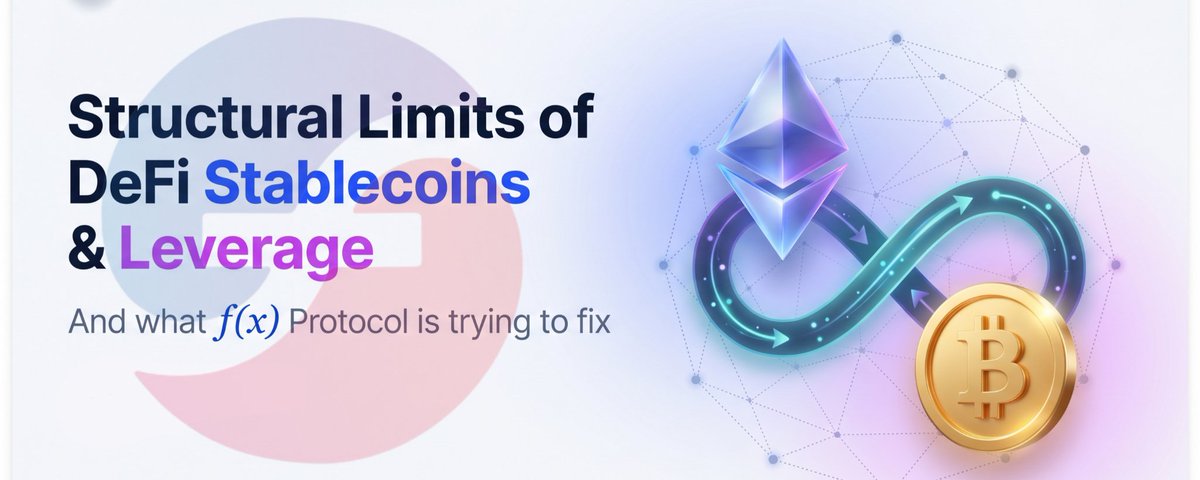 f(x) Protocol aims to fix DeFi's stablecoin and leverage flaws by linking fxUSD, leveraged positions, staking yield, and liquidity into a single system managing $152M TVL and $56M supply2026-05
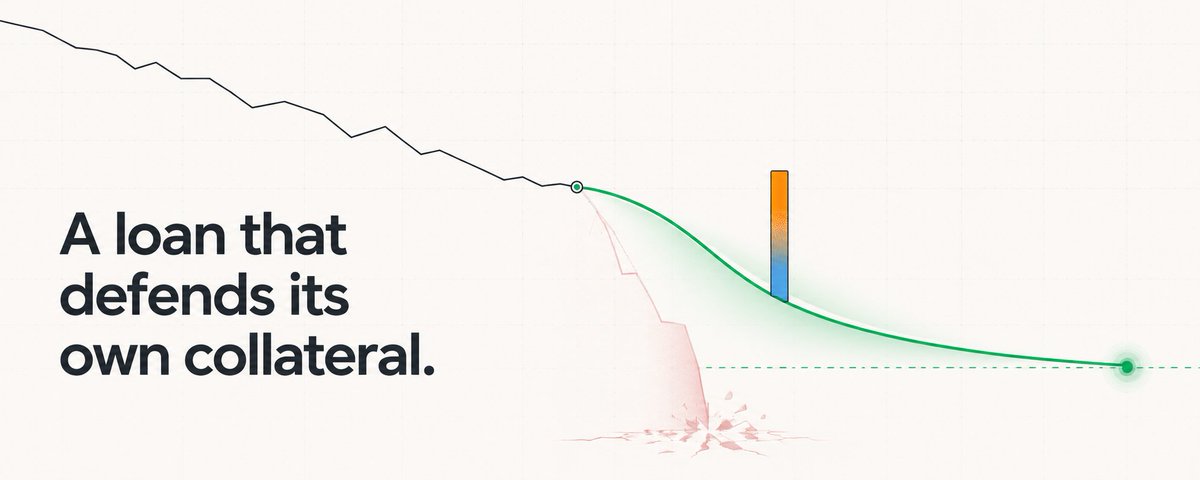 Inspired by Curve's LLAMMA and f(x)'s Liquidation Brake, protocol architect outlines a fixed-rate lending model where collateral self-hedges before liquidation thresholds are breached2026-06
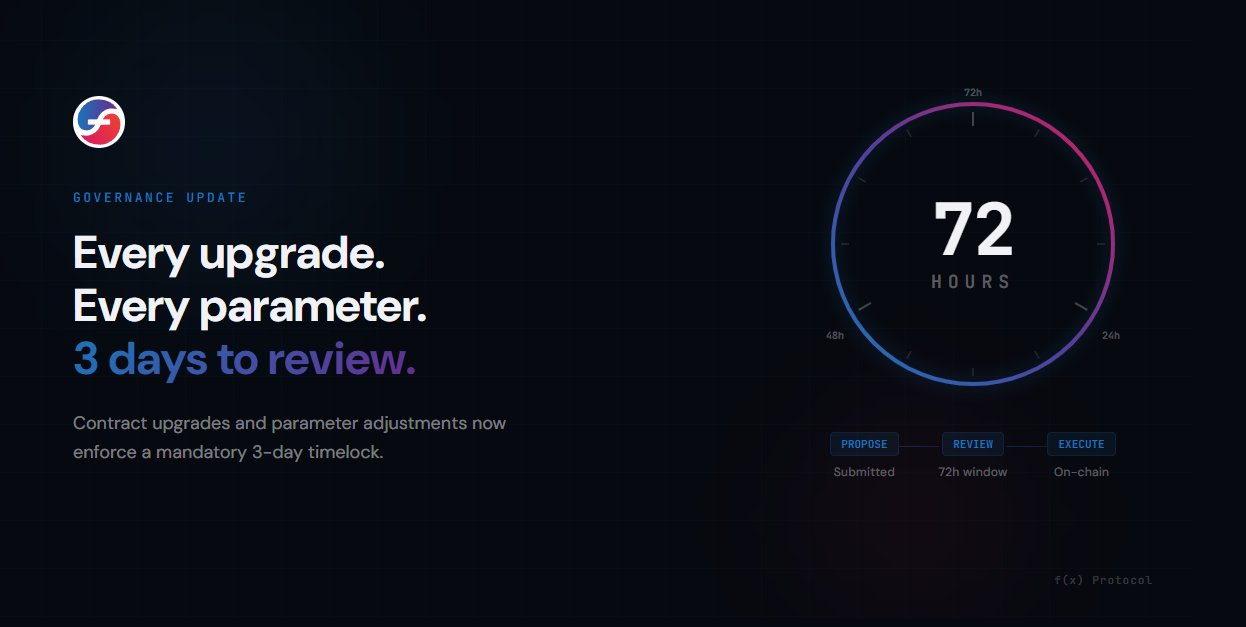 f(x) Protocol introduces a 3‑day on‑chain timelock and 6‑of‑9 multisig approval for all contract upgrades and parameter changes, with only oracle updates and emergency pauses exempted to protect users.2026-04
 f(x) Protocol partners with 9 Summits to debut an agentic fxUSD vault on Morpho, bringing leverage and liquidity to emerging AI-native assets.2026-02
 Stand up for trustless solutions on Ethereum.
Be part of the Trustless Force.
Join Curve, f(x), Liquity and Leviathan this Wed. 3pm CET.2026-01
Stand up for trustless solutions on Ethereum.
Be part of the Trustless Force.
Join Curve, f(x), Liquity and Leviathan this Wed. 3pm CET.2026-01
f(x) Protocol is an Ethereum-based system that connects fxUSD, individual xPOSITION longs, sPOSITION shorts, and a Stability Pool inside a shared reserve design. That current product map appears across the protocol's homepage and V2.1 whitepaper.
The useful way to understand f(x) is as a balance sheet whose parts place different demands on the same reserve. Long positions help create fxUSD. Short positions lock fxUSD while borrowing reserve collateral. Stability Pool deposits provide liquidity for peg management and stressed operations. When the first defenses fail, the system's published design specifies where losses move next.
That architecture changes the shape of familiar leveraged-trading costs without eliminating market risk. The protocol describes funding as normally inactive rather than impossible, and liquidation as a later defense after rebalancing rather than an event the system can never trigger.
The Current V2.1 Product Map
The protocol's public interface offers leveraged ETH and WBTC markets, but its homepage conflicts on whether fxUSD is backed by both wstETH and WBTC or solely by stETH. The same homepage also describes redemption for stETH or WBTC. Because those first-party statements conflict, the mechanism can be explained more confidently than the exact current reserve composition.
An xPOSITION is an individually tracked leveraged long. Opening an xPOSITION is accompanied by minting a proportional amount of fxUSD. The V2.1 whitepaper describes that paired creation as necessary to support the chosen target leverage.
An sPOSITION starts with fxUSD collateral and constructs the opposite exposure atomically. To open an sPOSITION, the user supplies fxUSD; an atomic transaction flash-borrows wstETH or WBTC, sells it for additional fxUSD, deposits the combined fxUSD as collateral, borrows the corresponding asset from the long-side reserve, and uses that borrowing to repay the flash loan. The sequence is documented in both the whitepaper and the current sPOSITION guide. Every step completes together or the transaction reverts.
These products are not conventional perpetual-futures accounts. The protocol's funding documentation describes trade execution against concentrated-liquidity pools, while reserve assets, position debt, peg conditions, and utilization determine exposure and any temporary funding charge.
Atlas uses up to 7x long and 6x short as the most specific current first-party ceiling while noting that official pages also describe 7x in either direction and an older 10x design goal. Those competing statements appear on the current homepage, in the V2.1 whitepaper, and in the current risk parameters, which list a 1.1x-to-7x range without splitting the ceiling by side. Leverage limits are mutable market parameters, so the live interface remains the operational reference for a trade.
Valueverse's Accrual revenue tracking platform announces listing of f(x) Protocol's $FXN, Stake DAO's $SDT, and Ramses $RAM
One Reserve, Several Claims
Under the V2.1 accounting design, adjusted reserve value equals the combined net asset value of fxUSD, xPOSITIONs, and sPOSITIONs. The whitepaper expresses this as the core invariant. A long requires the reserve to support both the position and fxUSD created alongside it; a short locks fxUSD while borrowing an asset from the long-side reserve.
Price changes alter the value and leverage of individual positions, but every product remains part of the same accounting system. That invariant is a design rule, not a promise that every exit will execute at a preferred price or time. Settlement still depends on oracle updates, market liquidity, keeper execution, smart contracts, and configured risk controls.
Readers click f(x) Protocol stories most when they validate the core promise under real stress — the $300M ETH liquidation-survival story outperformed every product launch, revealing that the audience treats protocol resilience proofs as more valuable than feature announcements.
The Liquidation Brake Rebalances First
Both position types are designed to rebalance at a threshold before reaching a separate liquidation threshold; failed or insufficient rebalancing can still end in liquidation. The sequence is described by the homepage, the current Liquidation Brake documentation, and the current risk framework.
For an xPOSITION, keepers repay part of the fxUSD debt and reduce the position toward the rebalance line. For an sPOSITION, keepers repay part or all of the borrowed reserve asset. The trader retains a smaller exposure rather than being closed immediately. Rebalancing carries execution and bounty costs, and it cannot prevent losses when the underlying market moves against a leveraged position.
The current Stability Pool documentation and V2.1 whitepaper describe an additional liquidity dependency. xPOSITION rebalances and liquidations can redeem fxUSD from the Stability Pool and exchange reserve collateral for USDC. If pool liquidity is insufficient, additional collateral may be sold, and settlement may proceed synchronously or asynchronously depending on market conditions.

f(x) Protocol aims to fix DeFi's stablecoin and leverage flaws by linking fxUSD, leveraged positions, staking yield, and liquidity into a single system managing $152M TVL and $56M supply
The Stability Pool Does Several Jobs
The Stability Pool accepts fxUSD or USDC, supplies liquidity for stressed operations, earns stated protocol rewards, and trades around the fxUSD/USDC market as a peg keeper. Its current documentation lists reserve yield, position fees, external strategy yield, and FXN emissions among possible reward sources. The precise mix depends on the pool and current program.
As a peg keeper, the pool can use USDC to buy fxUSD below parity and exchange fxUSD for USDC when the reverse trade is favorable. Deposits are valued with a Chainlink USDC price, and the documented design suspends deposits and some peg-keeping actions during a USDC depeg.
These roles connect yield to system function. Depositors supply liquidity that may be used under stressed conditions, so returns remain exposed to smart-contract, oracle, stablecoin, strategy, and withdrawal-liquidity risk.
- 01Liquidation-free leverage proof
The protocol's claim of non-liquidatable xPositions drew readers specifically when a live market stress event tested it — abstract promises became concrete validation.
- 02sPOSITIONs fixed-leverage shorts
A structured short product with no funding costs and a liquidation brake addresses a specific pain point traders know from perps, making it a sharp, differentiated pitch.
- 03Multi-asset stablecoin expansion
Each new collateral-backed stablecoin (fxUSD, arUSD via LRTs, btcUSD via WBTC) signals protocol breadth and unlocks new yield/leverage pairs readers want to track.
- 04Convex and ecosystem integrations
cvxFXN brought Convex's vote-locked flywheel into the picture, signaling maturity and aligning f(x) with an established DeFi power base readers already follow.
- 05RPC failure incident and keeper risk
The rare liquidations caused by parallel RPC endpoint failure revealed that keeper infrastructure — not the math — is the protocol's real operational vulnerability.
- 06TVL milestones and growth signals
Readers tracked the wstETH TVL climb (9,500 → 10,000+) as a proxy for conviction, treating milestone coverage as social proof rather than raw financial data.
Funding Is Normally Off, Not Impossible
Protocol funding is normally off but can activate during fxUSD peg stress or high short-side reserve utilization. The whitepaper and current funding FAQ describe temporary charges intended to reduce excess fxUSD supply, attract Stability Pool liquidity, or discourage shorts from consuming too much long-side collateral. Opening, closing, rebalance, liquidation, and swap costs can also apply according to the event.
For ETH shorts, current documentation says debt is wstETH-denominated, so its value rises with wstETH yield even when temporary protocol funding is off. The sPOSITION guide states this separately from the protocol's temporary funding levels. An inactive funding switch therefore does not make ETH-short debt economically costless.
Exact funding thresholds and rates are governance-adjustable. They belong in a live parameter surface rather than an evergreen prose snapshot.
Inspired by Curve's LLAMMA and f(x)'s Liquidation Brake, protocol architect outlines a fixed-rate lending model where collateral self-hedges before liquidation thresholds are breached
V1 Used Pooled xTokens, Not xPOSITIONs
V1 used pooled, fungible, variable-leverage xTokens, whereas V2/V2.1 uses individually tracked xPOSITIONs and sPOSITIONs. That version distinction is supported by the current homepage, the V2.1 whitepaper, and the official version FAQ.
In V1, holders of a fungible xToken shared pooled amplified exposure while reserve yield accrued to the stability side. V2 changed the unit of risk: a trader now has an individual position with its own collateral, debt, rebalance path, and liquidation path. Adding sPOSITIONs extended that per-position structure to shorts. Calling V1's xTokens xPOSITIONs erases the central design change.
- 2023-08launch
Protocol v1 launches, ETH cap hits 1,000 ETH limit within days
- 2023-08milestone
Cap doubled to 2,000 ETH after reaching initial limit in five days
- 2023-10launch
FX token sale sells out for 300 ETH in under one minute
- 2024-03exploit
RPC endpoint failure causes rare liquidations; airdrop promised to affected users
- 2024-07governance
f(x) Protocol v2.0 whitepaper published
- 2024-09launch
f(x) Protocol v2 goes live on Ethereum mainnet
- 2024-11milestone
Convex adds cvxFXN, integrating f(x) into its vote-locking ecosystem
- 2025-04launch
fxSAVE savings vault and sPOSITIONs fixed-leverage shorts launch
What Happens After Rebalancing Fails
Current official risk materials describe a sequence of rebalancing, liquidation, Reserve Fund coverage, same-side bad-debt redistribution, recapitalization, and system-level deleveraging. The sequence appears in the V2.1 whitepaper, the recently updated risk framework, and the V2.1 audit report.
The Reserve Fund is intended to absorb bad debt after rebalancing and liquidation are exhausted. If it is insufficient, short-side debt is first allocated across healthy sPOSITIONs and long-side debt across active xPOSITIONs. More extreme states can force recapitalization, one-off charges, position reductions, or system-level deleveraging. These rules allocate losses; they do not erase them. Their protection also depends on live funding balances, liquidity, keeper performance, and deployed parameters that are not frozen into this page.
- Smart contractMedium
The protocol has undergone 16 audits across three security firms — Trail of Bits, OpenZeppelin, and Secbit — but the f(x) invariant math and dual-token model introduce novel complexity that standard audits may not fully stress-test.
- Keeper / infrastructure centralizationHigh
A confirmed incident where parallel RPC endpoint failures caused liquidations shows that off-chain keeper liveness is a hard dependency and a single point of failure under network stress.
- LiquidityMedium
arUSD is backed by liquid restaking tokens (LRTs) which themselves carry redemption queue risk; a coordinated LRT withdrawal crunch could stress arUSD's peg.
- Market / volatility absorptionHigh
xPosition holders absorb all price volatility for the paired stablecoin — in extreme downturns, xPosition NAV can approach zero before the system rebalances, concentrating tail-risk on leveraged side.
- Slashing / LSD penaltyLow
wstETH and LRT collateral introduce Ethereum validator slashing exposure, though diversified validator sets and insurance mechanisms keep this risk historically low.
- RegulatoryMedium
Offering structured leverage products and yield-bearing synthetic dollars without KYC on Ethereum mainnet places f(x) squarely in scope for evolving DeFi leverage and stablecoin regulations across major jurisdictions.
Contracts, Audits, and Control Surfaces
The current site says 16 audits were conducted and all deployed code is audited; Atlas treats that as a team claim rather than an independent guarantee. The wording appears on the current site, while the official audit index lists scope-specific reports.
The July 2025 SECBIT V2.1 report covers long and short pools, funding, liquidation, reserve-pool, and bad-debt paths, and marks five High findings as fixed. The report identifies reviewed commits and also discusses short-pool insolvency socialization and position reductions. An audit remains limited to its code, commits, assumptions, and dates; it is not a warranty against economic failure, oracle failure, governance mistakes, or later code changes.
The public sources reviewed for this page do not provide a canonical current address map connecting the audited V2.1 commits to every live proxy and authority. Accordingly, the page does not repeat the former Atlas page's precise timelock or multisig configuration.
What Readers Should Track
f(x) combines a stablecoin, leveraged longs, leveraged shorts, and an active liquidity buffer inside one reserve design. Its central distinction is progressive risk handling: rebalancing before liquidation, pool liquidity before broader settlement, and explicit rules for allocating tail losses.
Readers should track leverage caps by market and side, the current composition of fxUSD backing, Stability Pool liquidity and reward sources, funding activation, oracle and keeper performance, the funded size of the Reserve Fund, deployed contract versions, and current administrative authorities.
This page was checked against first-party public sources on July 15, 2026. A previously missed correction now separates the pooled xTokens used in V1 from the individual xPOSITIONs used in V2/V2.1. f(x) and AladdinDAO did not participate in or endorse this replacement. Source-linked factual corrections are always free and do not imply endorsement, sponsorship, partnership, or co-authorship.
Latest f(x) Protocol news
Valueverse's Accrual revenue tracking platform announces listing of f(x) Protocol's $FXN, Stake DAO's $SDT, and Ramses $RAMf(x) Protocol aims to fix DeFi's stablecoin and leverage flaws by linking fxUSD, leveraged positions, staking yield, and liquidity into a single system managing $152M TVL and $56M supplyInspired by Curve's LLAMMA and f(x)'s Liquidation Brake, protocol architect outlines a fixed-rate lending model where collateral self-hedges before liquidation thresholds are breachedf(x) Protocol introduces a 3‑day on‑chain timelock and 6‑of‑9 multisig approval for all contract upgrades and parameter changes, with only oracle updates and emergency pauses exempted to protect users.f(x) Protocol partners with 9 Summits to debut an agentic fxUSD vault on Morpho, bringing leverage and liquidity to emerging AI-native assets. Harbor, a friendly f(x) Protocol fork, has started their early liquidity seeding round.
Sources
11 records from 3 domains
fx.aladdin.club
github.com
fxprotocol.gitbook.io
- Creating a Leveraged SHORT Position (sPOSITION)
- Rebalancing the Position (Liquidation Brake)
- Stability Pool — fxUSD/USDC deposits, Chainlink peg controls, wstETH/WBTC rewards, and FXN emissions
- How f(x) minimizes funding costs or annual interest
- What is the difference between f(x) Protocol V1 and V2?
- f(x) Protocol risk framework
- f(x) Protocol audit reports index
- f(x) Protocol risk parameters
Community notes
Spot something off or out of date? Drop a note. Editors review topic notes daily and roll accepted fixes into the explainer — contributors are recognized in the monthly $SQUID drop.
Loading notes…
Help improve this topic
Have a story or tip about this topic? Submit it. See something missing? Leave a note. Editors review daily; accepted submissions and fixes count toward the monthly $SQUID drop.