
A guide to crypto investment covering institutional adoption, Bitcoin ETFs, RWA tokenization, risk frameworks, and market cycle dynamics for informed capital allocation in digital assets.
+54 sources across the wider coverage universe
 GSR taps Standard Chartered-backed tokenization firm in web3 investment bank push2026-04
 Grayscale highlights generational shift as 45% of Gen Z and Millennials own crypto vs 18% of older investors, with $110T wealth transfer seen as major adoption tailwind2026-04
 Totalis closes $500K Y Combinator seed in first all-USDC investment settled on Solana2026-04
 Former CFTC chair 'Crypto Dad' Giancarlo leaves Willkie Farr for crypto advisory and private investing2026-04
 Tezos backs Metals platform bringing gold, uranium, and rare earth assets onchain, enabling investors to access critical materials driving AI and industrial growth2026-04
 TAP, Inc. launches TAP Terminal, unifying brokerage and digital assets for retail investors2026-04
Deploying capital into digital assets requires the same analytical discipline as any other asset class — but with a risk profile, regulatory landscape, and technological velocity unlike anything traditional markets have seen.
What "Investment" Means in the Crypto Context
In traditional finance, investment means allocating capital today to generate returns over time — through appreciation, income, or both. In crypto, that definition holds, but the instruments, risks, and market mechanics differ substantially. Participants range from retail buyers holding Bitcoin on a consumer exchange to sovereign wealth funds acquiring tokenized real-world assets onchain. The spectrum between those poles has grown dramatically since 2020, and that expansion is still accelerating.
Understanding where you sit on that spectrum — and what instruments, time horizons, and risk tolerances apply — is the starting point for any serious analysis of crypto investment.

Robinhood weighs issuer consent for tokenized stocks, citing investor property rights

The Institutional Turn
For most of Bitcoin's first decade, institutional participation was largely theoretical. That changed structurally in January 2024, when the U.S. Securities and Exchange Commission approved spot Bitcoin ETFs from issuers including BlackRock, Fidelity, and Ark Invest. The products gathered tens of billions in assets within months, making Bitcoin accessible to pension funds, endowments, and registered investment advisors operating under fiduciary constraints.
The institutional story is not uniformly bullish, however. U.S. spot Bitcoin ETFs recorded a record $6.35 billion in net outflows over a single 30-day window in mid-2025, signaling that institutional money is as capable of rapid exit as it is of rapid entry. Macro headwinds — including hawkish Federal Reserve projections and elevated inflation expectations — drove correlated sell-offs across Bitcoin, Ethereum, Solana, and XRP simultaneously, underscoring how closely crypto has become integrated with broader risk-asset sentiment.
Despite short-term volatility, the structural adoption curve continues. Japan's National Business Corporate Pension Fund announced plans to allocate approximately 1% of its total assets under management to cryptocurrencies within fiscal year 2026, investing through passive funds. For a pension fund to make such a move is a meaningful signal: it indicates that custody infrastructure, regulatory clarity, and risk frameworks have matured enough for conservative long-duration capital to enter the space.
Ark Invest's ongoing accumulation of Coinbase shares — purchasing $18.4 million across three ETFs in a single recent transaction while trimming Robinhood exposure — illustrates another institutional vector: investing in crypto infrastructure companies rather than digital assets directly. Coinbase's expansion into tokenized stocks and AI-powered brokerage functions makes it a proxy bet on the entire sector's growth.
Readers are running a credibility audit on institutional crypto investment: the highest-clicked stories all pit a billion-dollar promise against reality — whether that's a sovereign fund going silent, a stablecoin issuer buying farmland, or Wall Street warming to BTC while still calling it speculative — revealing that legitimacy anxiety, not yield mechanics, drives engagement on this topic.
Bitcoin as the Anchor Asset
Bitcoin remains the default "first position" for most institutional crypto allocators, largely because of its fixed supply, liquidity depth, and the regulatory clarity that the ETF approvals provided. Michael Saylor's Strategy (formerly MicroStrategy) pioneered the corporate treasury model of holding Bitcoin as a primary reserve asset, and the company's continued presence in markets shapes sentiment.
When Strategy announced a Bitcoin sale to fund dividends, some interpreted it as bearish — a signal that even the most committed Bitcoin holder was liquidating. Cypherpunk pioneer Adam Back pushed back on that reading, arguing that the sale reflected routine treasury management rather than a loss of conviction. The debate is instructive: in a market where narrative drives as much price action as fundamentals, parsing the reason behind large transactions matters as much as the transactions themselves.
The supply math also deserves attention. With a 21 million coin hard cap and a significant portion of Bitcoin provably inactive for a decade or more — some estimates place permanently lost coins in the millions — the effective circulating supply is meaningfully smaller than the nominal figure. This scarcity argument underpins the long-term investment thesis for many holders, independent of short-term price cycles.

Bitwise shuts down its Dogecoin ETF just 10 months after launch as BWOW struggles to attract investors beyond its $3M debut trading volume

Beyond Bitcoin: The Expanding Investment Universe
Crypto investment is no longer synonymous with Bitcoin and Ethereum. Several adjacent categories have drawn institutional capital:
Real-World Assets (RWA) and Private Credit Onchain Kaia Investment Partners is bringing collateral-backed, enterprise-grade Korean private credit onchain via KaiaChain — an example of a broader trend where traditional fixed-income instruments are tokenized to gain settlement efficiency, programmability, and 24/7 liquidity. Token Terminal's redesigned stablecoin and RWA issuer dashboards, launched recently, give investors deeper insights into product mix, market share, and chain distribution for these instruments. The Proof of Talk conference at the Louvre Palace in Paris convened Web3 and AI leaders to discuss where tokenized markets are creating "durable investor opportunity, moving past the pilot phase."
Prediction Markets Kalshi, the regulated prediction market platform, has reportedly begun IPO talks with investment banks after surpassing $2 billion in annualized revenue and reaching a $22 billion valuation in its latest funding round. This trajectory suggests that prediction markets — long dismissed as niche — are maturing into an institutional-grade asset class with their own liquidity and analytics infrastructure.
Pre-IPO and Secondary Markets Forge Global recently expanded investment opportunities for Ripple pre-IPO shares, illustrating how secondary markets for private crypto-adjacent companies are becoming a distinct investment category. As crypto companies approach public listings, pre-IPO participation has become a way for sophisticated investors to gain exposure ahead of retail access.
AI × Crypto Convergence Amazon's reported decision not to release a Sam Altman film following a $50 billion OpenAI investment underscores how intertwined the AI and crypto investment narratives have become — not always productively. The "on-chain AI economy" is a real area of builder activity, but investors should distinguish between genuine infrastructure development and narrative-driven token speculation. Events bringing together AI builders and Web3 founders are proliferating, but identifying durable investable themes within that noise requires rigorous filtering.
- 01Sovereign Bitcoin reserve bets
US government, El Salvador, and alleged Qatar sovereign wealth fund positioning in BTC as macro debt-reduction or reserve strategy drew readers tracking state-level adoption credibility.
- 02Billion-dollar fund promise failures
Abu Dhabi's Venom Ventures delivering silence on its $1B pledge epitomizes a pattern readers recognize — outsized announcements followed by accountability voids.
- 03Pig-butchering and fraud at scale
Organized crypto investment fraud (pig-butchering, Bangkok raids, MEXC warnings) clicked heavily because readers want to understand how billion-dollar scam infrastructure operates, not just that it exists.
- 04Tether empire diversification
Tether expanding into agriculture, doubling staff, and making strategic investments signaled to readers that the dominant stablecoin issuer is quietly becoming a conglomerate under pressure from competition.
- 05Institutional tokenization deals
BlackRock, Superstate, Societe Generale, and Mantra's Damac partnership represent TradFi converting real assets to on-chain investment vehicles — readers tracked this as proof-of-adoption, not just hype.
- 06Regulatory gating of crypto investment
SEC charging Abra as an unregistered investment company, ESMA clarifying MiCA governance-token exclusions, and Nasdaq's ETF rule proposal collectively defined where legal investment boundaries are being drawn.
Risk Factors Investors Cannot Ignore
Market Structure Volatility Crypto markets operate 24/7 with thin liquidity relative to global equity markets. A single macroeconomic signal — a Fed rate projection, a CPI print — can trigger cascading liquidations across leveraged positions, amplifying moves that would be modest in traditional markets. The mid-2025 sell-off across major assets on hawkish Fed language is a case study in this dynamic.
Regulatory Uncertainty The Monetary Authority of Singapore recently added one of the world's largest crypto exchanges to its investor warning list, a reminder that regulatory posture varies significantly by jurisdiction and can shift rapidly. The European Securities and Markets Authority's 2025 Annual Report flagged ongoing supervisory mandates and market uncertainty as central concerns. Investors operating across borders must track regulatory developments as a core part of their due diligence.
Fraud and Bad Actors A jury recently found a California man guilty of multiple cryptocurrency and investment fraud schemes that defrauded investors of nearly $1 million. While the amount is modest relative to institutional flows, the case illustrates a persistent risk at the retail end of the market: the combination of complexity, irreversible transactions, and regulatory gaps creates fertile ground for fraud. Due diligence on counterparties, custody arrangements, and project teams is non-negotiable.
Cycle Risk Analysis from within the crypto industry warns that the next market cycle could be "brutal for unprepared investors." Historically, crypto cycles have compressed wealth creation and destruction into short windows. Investors who entered near cycle peaks in 2017 or 2021 waited years for recovery. Position sizing, leverage discipline, and clear exit criteria are not optional risk management — they are the difference between participation and destruction of capital.
Valinor Digital launches VBDC with Superstate FundOS, giving qualified investors onchain access to high-yield private credit through a basket of publicly traded BDCs

Frameworks for Evaluating Crypto Investments
No single framework translates perfectly from traditional finance to crypto, but several principles apply across contexts:
Fundamental Value Anchors: For protocol tokens, relevant metrics include fee revenue, active addresses, total value locked (TVL), and developer activity. Token Terminal and similar platforms have made on-chain fundamental data increasingly accessible. For tokenized real-world assets, the same credit analysis applied to traditional instruments is appropriate.
Liquidity Assessment: Illiquid positions in small-cap tokens carry risks that don't appear in headline return figures. Bid-ask spreads, market depth, and exchange listing breadth matter for anyone who needs to exit a position without moving the market.
Custody and Counterparty Risk: The collapses of FTX and other centralized platforms demonstrated that "not your keys, not your coins" is not just a slogan. Institutional custodians with insurance, regulatory oversight, and segregated accounts represent a different risk profile than unregulated exchanges.
Regulatory Jurisdiction: Where a project is incorporated, where its founders operate, and which regulators have taken an interest are material facts for any investment decision.
Time Horizon Alignment: Short-term trading, medium-term cycle positioning, and long-term structural holding are three different strategies requiring different tools and risk tolerances. Conflating them is a common source of portfolio damage.
- 2024-03launch
BlackRock launches BUIDL tokenized Treasury fund on Ethereum
- 2024-02milestone
a16z leads $100M investment into EigenLayer restaking protocol
- 2024-06regulatory
Nasdaq proposes rule to list digital asset-based investment interests
- 2024-12regulatory
ESMA publishes final MiCA guidelines excluding governance tokens from collective investment rules
- 2025-01launch
Cantor Fitzgerald, SoftBank, Tether, and Bitfinex form $3B Bitcoin investment venture
- 2025-02milestone
Tether announces $100M investment in agriculture firm Adecoagro amid stablecoin competition
- 2025-03governance
Berachain's leaked documents reveal $25M refund right granted to Brevan Howard Nova Digital
- 2025-04regulatory
SEC charges Abra for unregistered crypto asset securities and operating as unregistered investment company
The Role of Diversification
DWF Labs describes its model as spanning stages — investor at pre-seed and seed, liquidity provider as traction builds, market maker as projects mature. That continuum illustrates a sophisticated approach to portfolio construction that most retail investors cannot replicate, but the underlying principle — that different instruments serve different roles in a portfolio — is universally applicable.
Bitcoin and Ethereum serve as liquid, higher-cap anchors. RWA tokens and private credit instruments offer yield with different risk profiles. Infrastructure equities like Coinbase provide regulated exposure with earnings. Early-stage protocol investments carry venture-level risk with the potential for venture-level returns. Understanding how each category behaves in different market conditions is the foundation of portfolio construction.
- RegulatoryHigh
SEC enforcement against unregistered investment vehicles (Abra), ESMA's MiCA asset-classification rules, and persistent banking friction for crypto hedge funds create a multi-jurisdiction compliance minefield for any investment structure.
- Counterparty / FraudHigh
Pig-butchering operations have industrialized to billion-dollar scale with Asia-based coordination, and unlicensed solicitation (Bangkok, MEXC) continues at fintech events — retail investment faces a persistent, organized fraud layer.
- Market / SpeculativeHigh
Goldman Sachs framing BTC as speculative with no real use case, even while acknowledging a store-of-value case, reflects the unresolved valuation debate that keeps institutional allocations cautious and volatile.
- CentralizationMedium
Tether's simultaneous expansion into agriculture, AI, Bitcoin mining, and digital education — while controlling dominant stablecoin market share — concentrates systemic influence in a single unregulated entity.
- LiquidityMedium
Tokenized fund structures (BlackRock BUIDL, Superstate) and VC lock-up mechanisms like Berachain's $25M refund right for Brevan Howard expose structural liquidity asymmetries between institutional and retail participants.
- Execution / DeliveryMedium
Abu Dhabi's Venom Ventures failing to deploy its announced $1B commitment illustrates that announced crypto investment vehicles frequently underdeliver, with no accountability mechanism once the press cycle ends.
Outlook
The structural case for crypto investment is stronger than it was five years ago: regulated ETF wrappers exist, institutional custody is mature, on-chain fundamentals are measurable, and real-world asset tokenization is moving from pilot to production. Pension funds in Japan and elsewhere are beginning to allocate. The infrastructure for durable participation is in place.
What remains uncertain is the pace and shape of adoption, the regulatory trajectory in key markets, and how AI-adjacent narratives will interact with crypto market dynamics. The next cycle may bring extraordinary returns for well-positioned investors and severe losses for the unprepared — as every previous cycle has. Capital preservation, rigorous due diligence, and clear risk frameworks are not obstacles to returns; they are the prerequisites for capturing them.
Latest Investment news
Robinhood weighs issuer consent for tokenized stocks, citing investor property rightsBitwise shuts down its Dogecoin ETF just 10 months after launch as BWOW struggles to attract investors beyond its $3M debut trading volumeValinor Digital launches VBDC with Superstate FundOS, giving qualified investors onchain access to high-yield private credit through a basket of publicly traded BDCs First staked Tron ETF launches in the US, with Canary Staked TRX ETF trading as TRXS and allowing investors to earn exposure to TRX staking rewards
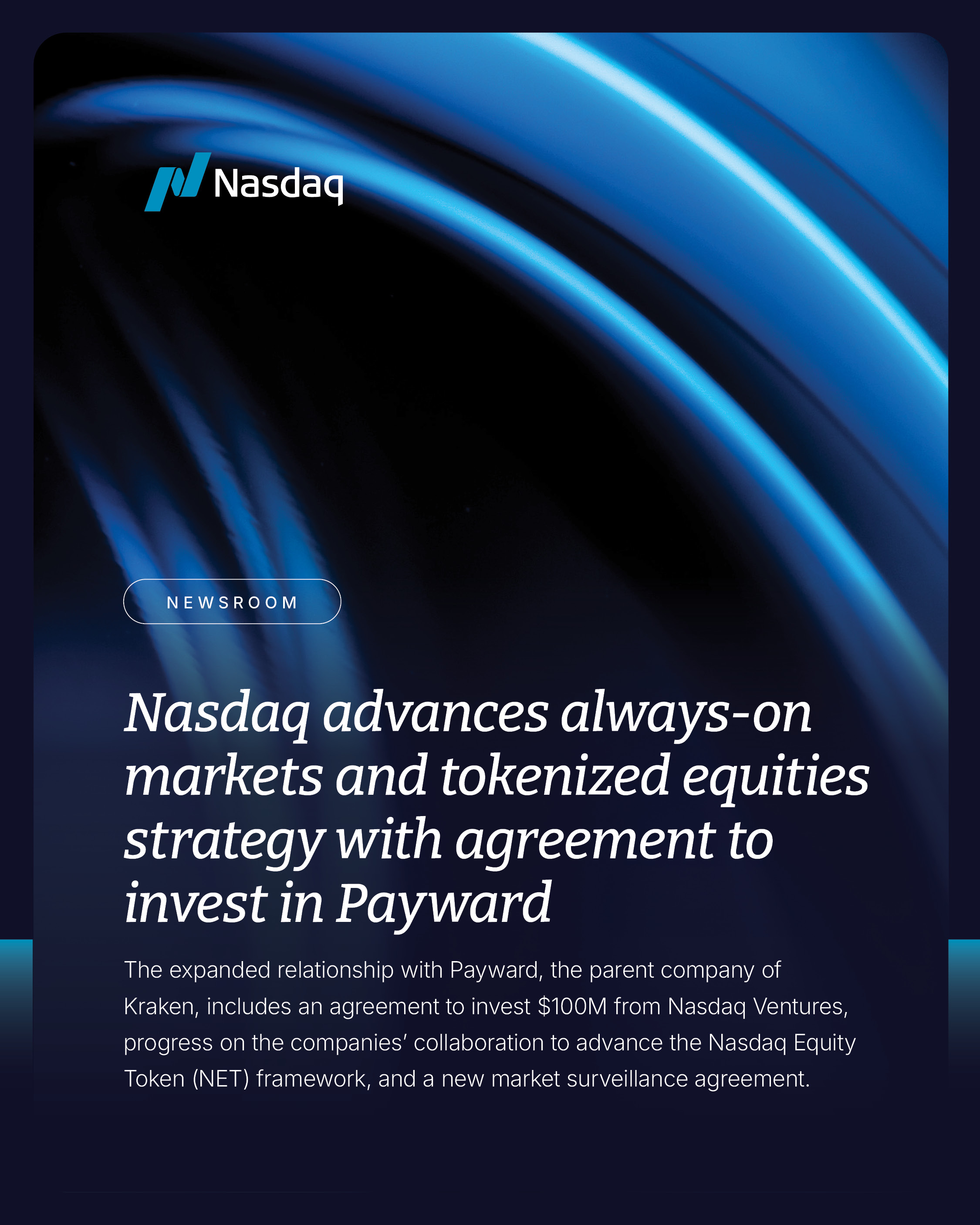 Nasdaq to invest $100 million in Kraken parent Payward at $21 billion valuation
Community notes
Spot something off or out of date? Drop a note. Editors review topic notes daily and roll accepted fixes into the explainer — contributors are recognized in the monthly $SQUID drop.
Loading notes…
Help improve this topic
Have a story or tip about this topic? Submit it. See something missing? Leave a note. Editors review daily; accepted submissions and fixes count toward the monthly $SQUID drop.