
Jupiter has grown from Solana’s default swap router into a broader onchain financial stack spanning spot execution, perpetuals, lending, stablecoins, tokenized assets, prediction markets, portfolio management, and JUP buybacks.
+5 sources across the wider coverage universe
 Jupiter launches Express Verification API, letting DEXes, launchpads, and agents integrate instant token verification directly into user flows and streamline onboarding2026-04
 Jupiter unveils cashback program with up to $1K monthly rewards, granting Superteam users top-tier 10% USD returns as collaboration drives deeper ecosystem engagement2026-04
 Jupiter Lend unlocks new asset class with xStocks, allowing users to borrow against SPYx, QQQx, NVDAx, and TSLAx while earning rewards and leveraging positions2026-04
 Jupiter launches Spot V2, merging Swap and Terminal into a unified Solana trading hub with live news, whale tracking, heatmaps and market signals2026-07
 WalletConnect handles $3.82 billion in Solana value during H1 2026, with Kamino and Jupiter driving 70%2026-07
 Ethena launches a dedicated lending market on Jupiter Lend, with Bitwise overseeing risk management and institutional participation on Solana2026-05
Jupiter on Solana: An Evergreen Guide to the “Everything Exchange”
Built on Solana, Jupiter is an onchain “everything exchange” that began as a decentralized exchange aggregator and expanded into perpetual futures, lending markets, stablecoins, prediction markets, tokenized equities, and portfolio tools accessed through a common interface. Its evolution reflects a larger change in decentralized finance: the most important applications are no longer merely websites sitting above independent protocols. They are becoming integrated financial systems that control routing, execution, collateral, distribution, and increasingly the economics attached to all four.
Jupiter is therefore best understood not as one exchange but as a coordination layer for Solana’s markets. Its original job was to find the best route through fragmented liquidity. Its broader ambition is to make the fragmentation beneath that route largely invisible, allowing a user to trade, borrow, lend, hedge, accumulate, and manage positions without repeatedly rebuilding context across different applications.
That integration offers a clear gain and an equally clear cost. A unified interface can reduce execution friction and make sophisticated onchain actions accessible to more people, but every additional product also adds contracts, counterparties, collateral relationships, and failure modes. Jupiter’s scale is a measure of convenience and distribution, not proof that every market available through it carries the same risk.
What Is Jupiter?
At its foundation, Jupiter is a liquidity router for the Solana ecosystem. Liquidity for a token pair can be scattered across automated market makers, order books, market-making systems, and pools with different fees and depths. A trader trying to choose among those venues manually would need to compare prices, estimate slippage, account for transaction costs, and decide whether a multi-step route through an intermediate asset produces a better result. Jupiter’s aggregator performs that search and packages the chosen route into a transaction the user can approve from a wallet.
The simplest analogy is a travel-search engine. An airline owns the aircraft and operates the flight; the search engine compares the available itineraries and assembles the most useful route. Similarly, the underlying liquidity venues hold or quote the assets, while Jupiter evaluates how a swap should travel through them. The analogy has limits because an onchain route can divide one order across several pools and settle the pieces together, but it captures the essential division of labor: Jupiter coordinates markets it does not necessarily own.
This model fits Solana particularly well. Low transaction costs make multi-hop and split-route execution economically practical for smaller trades, while high throughput supports the volume generated by active traders, automated strategies, and speculative token launches. Those properties do not guarantee good execution—liquidity depth, price impact, failed transactions, and adversarial ordering still matter—but they give an aggregator more room to optimize without transaction fees consuming the benefit.
From the user’s perspective, Jupiter can resemble a centralized exchange interface. A wallet connects, the user selects assets and an amount, and the application presents a quote. The important difference is in custody and settlement. Users generally retain control of their assets, sign transactions from their own wallets, and settle through Solana rather than depositing funds into an omnibus account controlled by the exchange. Jupiter orchestrates the transaction; it does not erase the risks of the contracts and assets involved.
This distinction is central to understanding the product. Non-custodial does not mean trustless in the everyday sense. A user may avoid trusting Jupiter with possession of funds while still depending on routing software, smart contracts, price oracles, token issuers, bridges, wallet software, and Solana itself. Self-custody changes where the risks sit. It does not make them disappear.
Jupiter’s remit expanded as it accumulated distribution. Once a large share of Solana users already relied on the router, adjacent products could be placed in front of the same audience: perpetual futures for leverage, dollar-cost averaging for scheduled execution, lending markets for credit, vaults for yield, and prediction products for event-linked trading. This shifts Jupiter from an aggregator into financial infrastructure—closer to an operating system for onchain positions than to a single-purpose swap page.
The expansion follows three reinforcing strategies. The first is aggregation, which makes fragmented external liquidity feel like one market. The second is vertical integration, through which Jupiter adds products and liquidity sources of its own. The third is economic capture: a broader product stack can generate more fees, some of which can be connected to the JUP token through buybacks and other incentive mechanisms.
The strategies strengthen one another, but they also create concentration. A router that becomes the interface for trading, credit, portfolio management, and discovery occupies an influential position even if the underlying protocols remain permissionless. Its decisions about routing, token presentation, verification, and integrations can affect which markets users see and where their orders travel. Jupiter is decentralized market infrastructure with a powerful distribution layer, not a neutral pipe without design choices.
Solana-wide usage provides one test of that position. WalletConnect’s report on Solana activity in the first half of 2026 says WalletConnect handles $3.82 billion in Solana value during H1 2026, with Kamino and Jupiter driving 70%. The measurement is specific to activity observed through WalletConnect rather than the whole Solana economy, but it still establishes that Jupiter was one of the principal applications in a large, identifiable channel of wallet-mediated value flow.

OpenCover expands risk protection to Solana, covering eligible positions across Kamino, Raydium, Orca and Jupiter with Nexus Mutual underwriting

Core Trading Products: Swaps, Perpetuals, and DCA
Spot swaps and DEX aggregation
Spot aggregation remains Jupiter’s foundation. For a straightforward SOL-to-USDC trade, the best route might be a single deep pool. For a less liquid token, Jupiter may divide the order among venues or route it through an intermediate asset. The relevant output is not merely the quoted exchange rate but the effective result after fees, slippage, and price impact.
This is why an aggregator should be judged like an execution broker rather than a token directory. The useful questions are observable: How much of the quote survives at settlement? How often do transactions fail? How does execution compare for small and large orders? Does the router find deeper paths during volatility? A long venue list is not evidence of good routing if the resulting fills are consistently inferior.
Aggregation creates benefits for liquidity providers as well as traders. Pools connected to a widely used router can receive order flow without persuading every trader to visit their own interface. That can improve capital utilization and make new venues viable. The trade-off is dependence: if the router changes how it ranks or selects pools, a venue can lose flow even though its contracts remain available onchain.
Many users encounter Jupiter indirectly. Wallets and decentralized applications can integrate its routing rather than constructing their own pathfinding systems. The user may believe they are making a wallet-native swap when Jupiter is supplying the route underneath. This embedded distribution is strategically important because it separates Jupiter’s reach from traffic to its own website. The protocol can function as wholesale execution infrastructure as well as a retail destination.
Solana’s speculative waves have provided an unusually hard test. When new tokens appear rapidly, liquidity may be shallow, prices can move between quote and settlement, and malicious or low-quality assets can imitate legitimate projects. A router can find a path through those markets, but routing cannot transform weak liquidity into deep liquidity or a fraudulent token into a sound asset. Better aggregation reduces one class of execution problem; it does not solve the investment problem.
The same distinction applies to price impact and maximum slippage. A transaction can execute exactly as authorized and still produce a poor economic result because the user accepted permissive settings in a thin pool. Conversely, an aggressive protection threshold may cause repeated failures in a fast market. Good execution tooling manages this tension by making costs legible and selecting robust routes, while the user still decides how much uncertainty to accept.
Jupiter’s spot product is therefore the narrow end of a broader funnel. A user may arrive to swap assets, then retain funds within the wider interface for a scheduled order, a lending position, or a derivatives trade. This is the onchain equivalent of a brokerage adding banking and portfolio products after winning the trading relationship. The convenience can be real, but it also means the interface increasingly shapes how users allocate capital after the original transaction.
Perpetual futures and leverage
Jupiter also offers perpetual futures, derivatives designed to track an underlying asset without a fixed expiry date. Perpetuals allow traders to obtain long or short exposure while posting collateral rather than buying or borrowing the full underlying position. Funding mechanisms help keep the contract price near the reference market, while liquidations protect the venue when collateral becomes insufficient.
Leverage makes capital more efficient in one direction and makes errors less survivable in the other. A trader can express a larger view with less posted collateral, but a relatively small adverse move can erase the margin supporting the position. Very high headline leverage should be interpreted as a narrow liquidation buffer, not as free purchasing power.
Onchain perpetuals differ from centralized exchange products principally in settlement and observability. Positions, collateral movements, liquidations, and some market parameters can be inspected through public infrastructure. That transparency gives analysts and traders tools for monitoring risk that do not depend entirely on an exchange’s private ledger. It does not ensure that the contracts, oracles, liquidation engine, or liquidity structure will behave safely under every market condition.
The combination of spot and derivatives products matters because it captures more of a trader’s lifecycle. A user can acquire collateral through the aggregator, move it into a leveraged position, hedge another exposure, and later unwind through the same general environment. For Jupiter, each step is another potential source of volume and fees. For the user, each step creates a new dependency that should be assessed separately.
Perpetual markets are also tightly connected to oracle quality. A spot swap relies on the prices available in executable pools. A leveraged derivative may rely on a reference price used to calculate profit, loss, funding, and liquidation. During a market dislocation, the integrity and latency of that reference can become as important as the visible liquidity in the trading interface.
A practical test is to examine more than the advertised leverage ceiling. Traders should look at available depth, open interest, funding rates, collateral rules, liquidation thresholds, and how the market behaved during volatile periods. The leverage number describes the maximum position structure; those other variables describe whether the market can support it.
DCA and execution tooling
Jupiter’s dollar-cost averaging tools address a different problem: execution over time. Instead of making one large purchase or sale, a user can divide an amount into a sequence of smaller orders. The strategy can reduce sensitivity to the price at a single moment and reduce the psychological pressure of choosing one entry, although it cannot guarantee a better average price.
A typical flow starts with a source asset, a target asset, a total amount, and an execution schedule. The protocol then submits tranches according to those parameters. Optional price constraints can prevent execution outside a user-defined range. The result resembles a standing instruction at a brokerage, except the assets and settlement remain onchain.
DCA changes timing risk rather than removing market risk. If an asset declines throughout the schedule, gradual buying can still generate losses. If it rises sharply from the outset, spreading purchases may produce a worse entry than a lump-sum trade. Its value lies in process discipline and reduced single-point timing exposure, not in an automatic return advantage.
Scheduled orders can also attract adversarial attention when their timing and size become predictable. Public blockchains allow specialized actors to observe pending activity and attempt to profit from transaction ordering. Sandwich attacks, for example, can place transactions around a user’s trade to worsen the user’s execution and capture the difference. Routing, scheduling, and transaction design can make such behavior harder or less profitable, but no public-market system can promise the complete absence of extractive strategies.
For professional users, these execution tools can be accessed programmatically. Market makers, funds, and automated strategies may use routing interfaces for inventory management, rebalancing, or hedging rather than manual token purchases. This gives Jupiter two distinct customer groups: people seeking a simple transaction screen and builders treating routing as a component inside a larger system.
That dual role creates a demanding standard. Retail users need legible controls and protection from predictable mistakes; professional users need reliable interfaces, deterministic behavior, and enough data to model execution. Serving both through the same liquidity network can deepen the system, but design choices optimized for one group will not always suit the other.
Readers are not clicking Jupiter stories for DEX performance metrics — they are tracking a vertical integration thesis: whether serial acquisitions (SolanaFM, Coinhall, Moonshot, SonarWatch), a stablecoin, a lending market, and tokenized equities will let Jupiter own Solana's entire financial stack before a competitor can.
Jupiter Lend, Vaults, and Stablecoin Liquidity
Jupiter Lend as a Solana money market
Jupiter Lend extends the platform from exchanging assets to financing them. In a non-custodial lending market, suppliers deposit supported assets to earn interest, while borrowers post collateral and draw other assets against it. Interest rates generally respond to utilization: when a large share of available liquidity is borrowed, rates rise to attract supply and discourage additional borrowing.
The traditional analogy is a secured credit line administered by software. The borrower retains economic exposure to the collateral while receiving liquidity in another asset. Unlike a bank loan, however, the system may liquidate collateral automatically when the position breaches its required ratio. There is usually no relationship manager and little room for negotiation after the threshold is crossed.
For suppliers, the displayed yield is compensation for a collection of risks. Those include smart-contract failure, borrower insolvency that exceeds liquidation capacity, oracle errors, collateral volatility, and problems with the supplied asset itself. A stablecoin deposit may have lower price volatility than a token deposit while still carrying issuer, depegging, and contract risk. Yield is a price for risk and liquidity demand, not a savings-account guarantee.
For borrowers, high loan-to-value ratios improve capital efficiency but reduce the distance to liquidation. A position that appears comfortably collateralized during calm conditions can deteriorate quickly when collateral falls, debt rises, or both occur together. Solana’s speed may help liquidators respond, but it also means a leveraged position can move from safe to closed with little time for manual intervention.
Jupiter Lend’s use of isolated vaults is an important architectural choice. Instead of treating every collateral asset as part of one undifferentiated balance sheet, isolated markets can assign separate collateral factors, caps, and liquidation settings. If a long-tail asset fails, the direct damage can be limited to the vaults exposed to it rather than automatically spreading across all lending activity.
Isolation is a firewall, not immunity. Vaults may still share code, administrators, price infrastructure, liquidators, or stablecoin dependencies. A system-wide software defect can cross boundaries that are effective against asset-specific losses. The right interpretation is narrower: isolation can reduce contagion from one collateral market when the shared infrastructure continues to function.
The integrated interface makes lending more accessible because a user can move from acquisition to collateralization without learning a separate application. It can also make leverage feel deceptively routine. When borrowing is presented beside swapping and portfolio tracking, the number of clicks falls faster than the underlying financial complexity.
Multiply strategies
Multiply strategies package a recursive leverage process. A user deposits an asset, borrows against it, swaps the borrowed proceeds into more of the original exposure, and repeats the loop. The result is a larger economic position than the starting capital alone would support.
The familiar comparison is buying an asset on margin, but the onchain route exposes the mechanics more directly. Borrowing rates, swap slippage, collateral factors, and liquidation thresholds all contribute to the outcome. A bullish price move can amplify gains; a decline can accelerate losses and trigger liquidation. The return must also exceed financing and execution costs before leverage adds value rather than merely volatility.
Packaged looping is useful because it replaces a sequence of manual transactions with one guided flow. The cost of that simplicity is that users may focus on the multiplier while overlooking the path that creates it. A sound evaluation starts with the liquidation price, the variable borrowing rate, and the liquidity available to unwind—not the largest exposure displayed by the interface.
Multiply also connects Jupiter’s business lines. The lending market supplies credit, the aggregator performs the swaps, and the resulting collateral remains inside the broader product environment. Vertical integration can make the route cheaper and smoother. It can also align several revenue streams around the same leveraged user, which is commercially attractive even when the user’s optimal decision is to avoid leverage.
Earning vaults and automated allocation
Earning vaults simplify the supplier side of lending by packaging strategies into a deposit experience. Rather than selecting and continually monitoring individual markets, a user can place funds into a vault whose logic allocates capital according to its mandate. This resembles a managed cash product, except execution occurs through smart contracts and the strategy’s constraints are encoded rather than administered through a conventional investment account.
Automation offers convenience and can react faster than a passive user, but it creates strategy risk. The vault may allocate toward the highest available rate precisely because a market is experiencing stress or unusually high demand. A headline annual percentage yield says what the current rate implies if conditions persist; it does not establish that the rate will persist or that principal is safe.
Users should distinguish between yield generated by organic borrowing demand and yield subsidized by incentives. Both are real while paid, but they have different durability. Borrower-paid interest depends on continuing demand for credit. Token rewards may fall when a campaign ends or when the reward asset loses value. A blended percentage can hide that difference unless the components are examined separately.
Vault composability allows external projects to build specialized products above Jupiter’s risk and liquidity machinery. That can expand the market faster than one team could build every interface itself. The double edge is that a Jupiter-connected product may introduce risks at its own layer, including strategy contracts, incentive tokens, or front-end controls that are not equivalent to Jupiter’s core markets.
JupUSD and stablecoin architecture
JupUSD represents Jupiter’s effort to establish a stable unit within its own product stack. A native stablecoin can serve as trading collateral, a lending asset, a settlement leg, and a vault deposit. Strategically, that is more valuable than supporting only an external stablecoin because the protocol can shape integrations and retain more of the surrounding economic activity.
Stablecoins should be classified by the mechanism supporting their target value, not by the shared word “dollar.” Fiat-backed tokens depend on reserves, banking access, redemption operations, and issuer controls. Synthetic or yield-oriented designs can depend on hedges, derivatives markets, collateral performance, and smart contracts. Two tokens targeting one dollar may therefore have materially different failure modes.
JupUSD complements established settlement assets such as USDC rather than making them economically interchangeable. USDC can serve users who prioritize a fiat-reserve model and broad existing liquidity. A Jupiter-native alternative can be designed more closely around onchain yield and Jupiter’s own credit markets. The gain is tighter integration and potentially more productive collateral; the cost is additional mechanism and counterparty risk.
The relationship between a stablecoin and a lending venue can form a useful flywheel. Lending markets create demand to borrow and supply the asset, trading markets provide liquidity, and vaults give holders a reason to retain it. The same loop can become reflexive under stress: falling confidence can reduce liquidity, raise borrowing costs, and pressure collateral or hedging arrangements at the same time.
A durable evaluation therefore requires more than checking whether the token currently trades near its target. Users can examine redemption terms, collateral composition, liquidity concentration, dependence on partners, and behavior during volatility. Price stability on an ordinary day proves that the peg is functioning under ordinary conditions; it does not establish resilience during a rush for exits.
Token Economics, Buybacks, and the JUP Thesis
The role of JUP
JUP sits at the governance and economic center of the Jupiter ecosystem. Governance tokens historically gave holders voting rights without necessarily giving them a direct claim on protocol income. That separation produced a recurring problem in decentralized finance: an application could attract meaningful usage while its token remained dependent on incentives, narrative, and expectations about future governance value.
Jupiter’s buyback model attempts to narrow that gap by linking protocol activity to recurring token purchases. The conceptual comparison is a corporate share repurchase, but the analogy needs qualification. A public company represents a legal claim with defined shareholder rights; a token’s rights depend on contracts, governance rules, and jurisdictionally uncertain arrangements. Similar mechanics do not make the instruments legally or economically identical.
A fee-funded buyback nevertheless creates a measurable bridge between product use and token demand. When revenue supports purchases in the market, observers can track fee generation, acquisition cadence, and the destination of repurchased tokens. That is more concrete than a promise that governance may become valuable someday.
Locking repurchased tokens adds a supply component. Tokens removed from active circulation cannot immediately return as sell-side liquidity. The benefit is a visible sink; the cost is deferred uncertainty because locked balances may eventually become relevant again depending on the rules in force. “Locked” and “burned” are not synonyms.
How to evaluate the buyback mechanism
The first variable is the fee base. A percentage of revenue sounds impressive only when placed beside the revenue available to fund it. Trading, derivatives, lending, and other products may contribute differently and may respond differently to market cycles. Analysts should distinguish durable fees from short-lived activity during speculative surges.
The second variable is net supply. Buybacks can absorb tokens while emissions, vesting, rewards, or other distributions add them. Looking at purchases without looking at new liquid supply produces an incomplete picture. The relevant question is whether the mechanism reduces effective float after all material sources of distribution are considered.
The third variable is governance durability. Token holders or authorized administrators may be able to change fee allocations, lock periods, or treasury policy. A current formula is evidence of the current economic arrangement, not a permanent constitutional guarantee. The more central buybacks become to valuation, the more consequential any governance change becomes.
The fourth variable is market depth. A fixed amount of buying has a different price effect in a deep market than in a thin one. Large purchases can support price, but they can also create expectations that reverse when revenue falls. A token priced as though peak buybacks will continue indefinitely can decline even while the program remains active.
Finally, token value depends on what holders can ultimately do. Governance influence, access, incentives, and supply effects may all matter, but they are not automatically equivalent to dividends or ownership. Jupiter belongs in the category of revenue-connected token systems, not conventional equity.
Revenue-generating tokens as a category
The broader move toward fee sharing and buybacks is a reaction to the weak alignment of earlier token models. Protocols often distributed tokens to attract liquidity, which generated usage, which justified further distribution. When incentives slowed, activity and token demand could fall together. A fee-linked model tries to reverse the direction: products generate economic output, and some of that output creates token demand.
That is a meaningful improvement in observability, but it does not guarantee a good investment. A shrinking business with buybacks may be less attractive than a growing business without them, and an overvalued revenue-linked token can still underperform. Cash-flow language makes analysis more disciplined only if analysts also examine growth, margins, competition, dilution, and governance.
Jupiter’s advantage is that its potential fee base spans multiple activities. Spot routing, derivatives, lending, and other markets need not peak at exactly the same time. Diversification can smooth revenue, although many of the products remain exposed to the same underlying Solana and crypto-market cycle. Several fee streams are not truly independent if all depend on speculative risk appetite.
This reclassifies the JUP thesis. It is not simply a bet that more people will use a swap interface. It is a bet that Jupiter can remain a principal distribution and execution layer as Solana finance broadens, that the resulting activity will produce defensible fees, and that governance will continue directing enough of those economics toward the token to matter.
Risks and incentive complexity
Buybacks do not remove token overhang. Team allocations, contributor distributions, incentive budgets, and other unlocks can create selling pressure. The correct comparison is between all sources of demand and all sources of liquid supply over time, not between one buyback transaction and the immediately preceding market price.
Incentive programs can also complicate the relationship between genuine usage and paid activity. Rewards may attract users who leave when subsidies end. That does not make the activity fictitious—subsidies are a normal way to bootstrap markets—but it means headline volume should be separated into behavior likely to persist and behavior purchased for the duration of a campaign.
Governance introduces another trade-off. Community participation can distribute authority and make economic policy more legitimate, but low turnout or concentrated voting power can allow a small group to determine parameters for a large user base. Formal token voting is evidence of a governance procedure, not proof of broad practical control.
The token also inherits the operational risk of the products supporting it. A major contract loss, oracle failure, or prolonged service disruption can reduce activity and confidence simultaneously. The buyback thesis is therefore downstream of product security. A revenue-linked token becomes more exposed to business performance, not less exposed to technical failure.
- 01Jupiter acquisition spree
Three separate acquisition stories collectively drew the highest engagement of any angle, showing readers are monitoring how Jupiter is buying, not just building, infrastructure dominance on Solana.
- 02Jupuary airdrop mechanics
The eligibility checker launch, the revised $860M DAO proposal targeting mercenary farmers, and the original JUP token launch all clustered near the top, indicating readers wanted to know whether they qualified and how distribution rules were changing.
- 03JUP buyback and supply pressure↗
The 50% fee-to-buyback pledge, the 30% supply reduction proposal, and the postmortem on the $70M buyback that failed to lift price drew readers tracking whether tokenomics changes could offset aggressive unlock schedules.
- 04AI ecosystem positioning
The ai16z/ElizaOS $10M Magic Fund partnership was the third most-clicked story, reflecting reader interest in Jupiter as a preferred DeFi rail for AI-agent capital allocation on Solana.
- 05Tokenized equities and pre-IPO onchain↗
PreStocks limit-order trading and the Securitize/Jump regulated equity launch pulled readers asking whether Jupiter could be the venue where traditional finance assets trade onchain.
- 06Governance trust crisis
The DAO suspending votes and Jupiter's public commentary on the LIBRA rug pull attracted readers questioning whether rapid product expansion had outpaced community oversight.
Tokenized Equities and Cross-Chain Assets
Tokenized equities as an extension of routing
Tokenized equities extend Jupiter’s routing model beyond crypto-native assets. In principle, an equity-linked token can be traded, transferred, or used as collateral through the same infrastructure as other Solana assets. That makes the user experience more unified, but the token’s legal and economic structure remains distinct from the ordinary SPL tokens beside it.
The crucial question is what the token represents. Some products may convey a regulated claim tied to an underlying security; others may provide synthetic price exposure without identical shareholder rights. Dividends, voting, redemption, custody, transfer restrictions, and eligible jurisdictions can differ. A matching ticker or price chart does not establish equivalence with a brokerage-held share.
Jupiter’s role as an access and liquidity layer is still strategically important. Tokenized assets become more useful when holders can trade them efficiently, borrow against them, or combine them with other positions. An isolated token representation with little liquidity is closer to a digital receipt than a functioning financial instrument. Routing and collateral infrastructure can turn static issuance into an active market.
The gain is composability: an equity-linked position can interact with stablecoins, lending, and crypto assets without leaving the chain. The cost is stacked dependency. The user may depend on the issuer, custodian, compliance framework, market maker, blockchain, oracle, lending protocol, and interface at once. Traditional market exposure has been made programmable, but not simpler in its underlying chain of assurances.
xStocks as collateral
Using tokenized equities as collateral changes them from trading instruments into financing instruments. A holder can retain exposure while borrowing another asset, or employ a looping strategy to increase the equity-linked position. This resembles securities-backed lending or margin finance, translated into automated vaults.
Isolated markets are particularly useful here because tokenized equities have different trading hours, reference markets, and legal constraints from continuously traded crypto assets. An onchain token may trade while the primary equity market is closed, potentially leaving thinner price discovery or wider spreads. Risk parameters need to account for those discontinuities rather than treating every token as a round-the-clock crypto asset.
Collateralization also creates feedback between the tokenized asset and Solana liquidity. If a position is liquidated, the system needs buyers and executable routes. A reliable reference price is insufficient when actual market depth cannot absorb the sale. Users can test this by comparing displayed collateral values with the size that can be sold at tolerable impact.
Hybrid portfolios introduce new possibilities and new correlations. A user can borrow stablecoins against an equity-linked token and deploy them into crypto markets, or hedge crypto exposure with a traditional-market proxy. Such combinations may look diversified at the asset-label level while remaining exposed to the same leverage, stablecoin, and liquidity infrastructure.
Wrapped assets and bridging
Wrapped assets bring value originating elsewhere into Solana through a representation that can move through local applications. Jupiter can then route that representation into SOL, stablecoins, or other tokens. This makes the aggregator a gateway for cross-chain portfolios as well as a router for native assets.
A wrapped asset is best understood as a claim or representation, not the original asset teleported between networks. Its value depends on the mechanism connecting the representation to the underlying asset. That mechanism may involve custody, smart contracts, messaging infrastructure, authorized issuers, or some combination of them.
The additional utility comes with additional failure modes. A bridge can fail while Jupiter’s router continues functioning correctly. A custodian can restrict redemption while the wrapped token still trades. A smart contract can be technically sound while the underlying asset becomes inaccessible. Integration into a major interface establishes tradability, not redemption certainty.
Cross-chain deposits and routes can reduce the friction of entering Solana. That is strategically valuable because every extra wallet, bridge screen, and manual conversion loses some users. A streamlined path makes Jupiter a distribution surface for capital before that capital reaches a swap or lending market.
The trade-off is abstraction. When the interface compresses bridging, conversion, and settlement into one action, users may not see which intermediary mechanisms are carrying the risk. Convenience should be paired with enough transaction detail to identify the representation received, the route used, and the parties or contracts responsible for redemption.
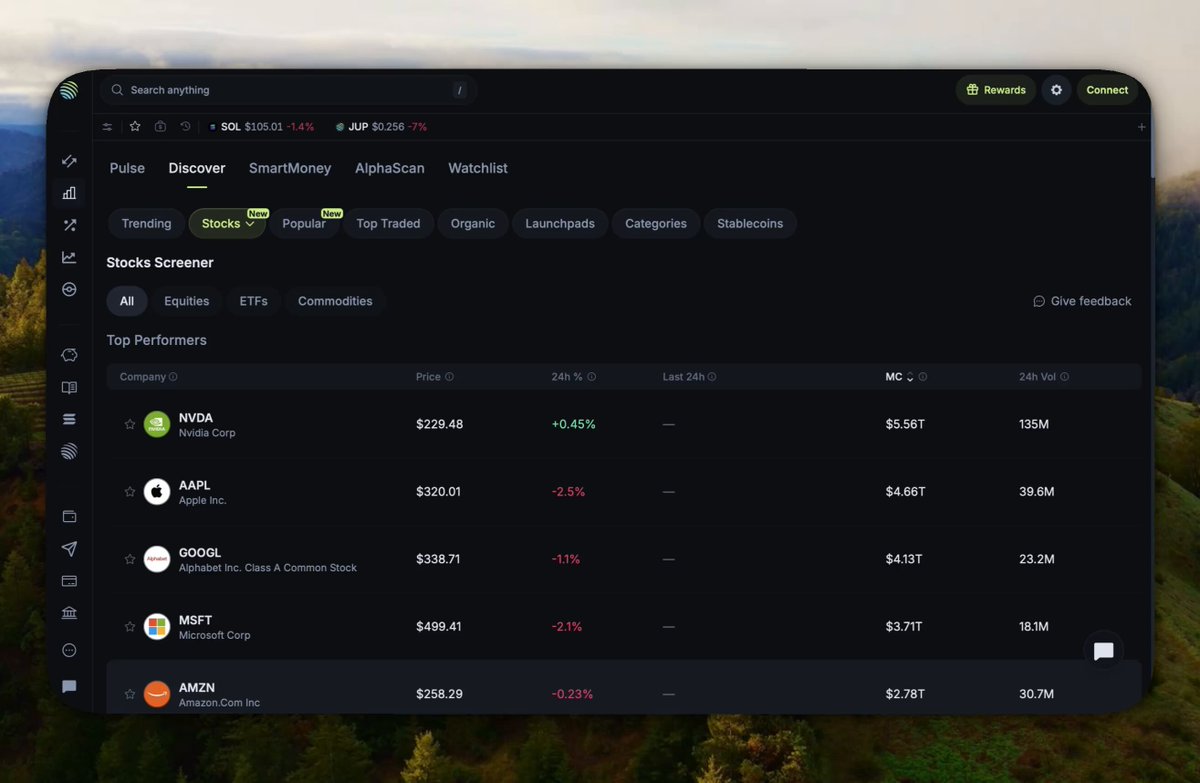
Jupiter launches early preview of stocks page with P/E ratios and dividend yields, seeks user feedback on additional indicators.
Prediction Markets, Social Trading, and Gaming
Prediction markets
Prediction markets allow participants to trade claims based on the outcome of an event. Their prices can serve as crowd-generated estimates, but only when market rules, liquidity, and resolution procedures are credible. A quoted probability from a shallow or easily manipulated market carries less informational weight than one supported by competitive trading and clear settlement terms.
Jupiter’s interest in prediction markets follows naturally from its routing background. Both token trading and event trading require price discovery, liquidity, order execution, and settlement. The underlying object changes—from an asset to a contingent payoff—but much of the market infrastructure is familiar.
A market-maker-oriented design can improve spreads and depth by giving professional liquidity providers more flexible tools. Better liquidity benefits retail users through more competitive prices. The cost is that market quality may depend heavily on a small set of sophisticated participants, especially in niche events where natural two-sided demand is limited.
Resolution risk is unique and important. A token swap settles against assets delivered in the transaction. A prediction contract may require someone or some mechanism to decide whether an event occurred according to predefined language. Ambiguous questions, disputed sources, delayed results, or governance intervention can matter more than the quality of the trading engine.
The observable tests are straightforward. Users can examine market depth, spreads, resolution criteria, designated information sources, and the history of disputed outcomes. A polished probability display does not by itself establish that a position can be entered at scale or settled without controversy.
Social distribution
Prediction products fit naturally into social environments because discussion and trading often occur together. Chat-based interfaces can shorten the distance between seeing an event, forming a view, and entering a position. That can expand participation, particularly among users who do not habitually visit DeFi applications.
The same compression raises behavioral risks. Social momentum can replace analysis, and a transaction presented conversationally may feel less consequential than an order ticket even when the financial exposure is identical. Embedding markets in chat improves distribution while making careful confirmation and risk disclosure more important.
For Jupiter, social distribution is another instance of infrastructure moving beneath the visible product. A user may initiate an action through a bot or partner application while Jupiter supplies liquidity or settlement. This resembles its wallet integrations: the protocol’s reach grows without every user adopting the flagship interface as a destination.
Gaming and tokenized participation
Jupiter’s experimentation with gaming and poker-related markets illustrates how broadly an execution layer can be applied. Tokenized participation in a player’s tournament performance combines elements of backing, revenue sharing, prediction, and fandom. It is financially legible because the payoff depends on a real-world result, but it does not fit neatly into the category of a conventional token swap.
Such markets can create a more engaging relationship between participants and performers. Fans gain economic exposure; players can distribute part of their risk or financing need. The cost is that settlement depends on accurate event results and clearly specified payout terms, while legal treatment may vary across jurisdictions.
Gaming products also test whether Jupiter’s brand can stretch beyond financial utility. A router is usually judged on execution. An entertainment platform is judged on content, retention, community, and trust in randomized or contingent outcomes. Shared settlement rails do not make those product disciplines identical.
The strategic logic is order flow. If Jupiter can provide a common wallet, funding asset, marketplace, and settlement layer across trading and entertainment, users have fewer reasons to leave its ecosystem. The risk is diffusion: every new category consumes engineering, security, and governance attention that might otherwise strengthen the core exchange and lending products.
Security, Verification, and Risk Management
Smart-contract and operational security
Jupiter’s broader product surface makes security a system-level concern. A swap router, perpetual venue, lending market, vault strategy, wrapped asset, and prediction contract fail in different ways. An audit of one component cannot be generalized into a blanket safety statement about the whole platform.
Independent audits are valuable because they can identify defects, challenge assumptions, and document the code reviewed. Their evidentiary boundary matters. An audit establishes that a particular scope and version received professional examination under specified conditions. It does not prove the absence of unknown vulnerabilities, protect later upgrades, or guarantee the behavior of external dependencies.
Operational controls such as multisignature authorization and timelocks address a different layer. A multisig can prevent one compromised key from unilaterally changing critical settings. A timelock can give observers time to detect and react to a scheduled change. Both depend on configuration: weak signer independence or broad emergency powers can reduce the protection implied by the label.
Circuit breakers can restrict activity when markets or systems behave abnormally. They may contain losses by pausing borrowing, withdrawals, or other actions. The trade-off is explicit: the ability to stop a system during an emergency introduces administrative discretion and may prevent users from acting when they most want access.
Real-time monitoring is similarly useful but bounded. It can detect known patterns and accelerate response; it cannot guarantee that an unfamiliar exploit will be recognized before damage occurs. Security maturity is best judged through layers—code review, constrained permissions, monitoring, incident response, and risk segmentation—rather than one certification.
Isolated vaults as containment
Risk isolation is one of the most important design choices in a multi-asset lending system. Each collateral type can receive parameters suited to its volatility, liquidity, oracle quality, and legal structure. Caps can limit how much exposure accumulates before the market has demonstrated resilience.
The known analogy is watertight compartments in a ship. A breach in one compartment need not sink the vessel, provided the barriers hold and shared systems remain intact. Isolated vaults can contain collateral-specific insolvency, but a flaw in shared code, administration, or pricing infrastructure can still reach several compartments.
Users should therefore ask both local and system-wide questions. What assets can impair this vault? Which contracts and oracles does it share with others? Who can change its parameters? How quickly can those changes take effect? Isolation is meaningful only when the actual dependency graph supports the label.
Token verification
High-velocity token markets create a discovery problem as much as a trading problem. Similar names, copied symbols, misleading metadata, and impersonation can direct users toward assets they did not intend to buy. Verification systems attempt to connect a token address with an identified issuer or recognized metadata record.
Jupiter’s verification framework can help interfaces and developers present more consistent signals. Programmatic verification is especially valuable for wallets, launchpads, and agents because it lets them reuse a common registry instead of maintaining independent lists.
A verification badge proves something narrower than many users assume. It can establish that an address or metadata submission passed a defined authentication process. It does not prove that the asset is valuable, solvent, legally compliant, or immune from issuer misconduct. Identity verification and investment quality are separate judgments.
Verification can also lag. New legitimate assets may remain unverified, while a verified project can later change behavior or suffer compromise. The practical test is to examine the exact contract address, the meaning of the displayed badge, issuer-controlled channels, and liquidity—not merely the token name.
Execution and MEV risk
Public transaction systems expose order flow to validators, block builders, searchers, and other actors who may influence ordering. A user can receive a technically valid fill while losing value to adversarial sequencing. The problem becomes more acute for predictable orders and illiquid assets.
Mitigation can operate at several layers: routing across venues, limiting slippage, altering submission methods, reducing order predictability, or using protected transaction channels. Each method changes the economics available to an attacker. None should be treated as a promise that extraction is impossible.
Users can compare quoted and settled amounts, monitor price impact, and avoid unnecessarily loose slippage settings. Larger orders can be divided or timed for deeper liquidity, although predictable division creates its own information leakage. Execution quality is an optimization problem with competing constraints, not a switch between “protected” and “unprotected.”
User-controlled risk
Some risk remains primarily behavioral. Leverage, permissive token approvals, unverified links, concentrated collateral, and poor key management can produce losses even when the underlying protocols work as intended. A non-custodial platform gives users control over authorization, which also gives them responsibility for mistaken authorization.
Conservative loan-to-value ratios provide more room for volatility. Position sizing limits the damage from one contract or asset. Hardware-backed or passkey-based signing can reduce some credential risks. Reviewing the actual transaction matters because a familiar interface can be imitated or compromised.
The most useful mental model is not “safe versus unsafe” but a stack of exposures. At the bottom sits Solana and wallet security. Above that sit Jupiter’s contracts and controls. Above them sit integrated venues, assets, issuers, bridges, and user-selected strategies. A failure at any layer may affect the final position even if every other layer performs correctly.
- 2024-01launch
JUP token launches on Solana with 1.35B circulating supply; Jupuary airdrop goes live
- 2024-09milestone
Jupiter acquires SolanaFM and Coinhall, announced at Solana Breakpoint Singapore
- 2024-11milestone
Jupiter acquires majority stake in Moonshot
- 2024-12governance
Jupiter DAO approves revised $860M Jupuary 2 airdrop with anti-mercenary-farming criteria
- 2025-02governance
Jupiter DAO suspends governance votes until early 2026 amid community trust concerns
Jupiter Lend powered by Fluid goes live on Solana
Securitize, Jump Trading, and Jupiter launch regulated onchain trading for tokenized equities
- 2025-05launch
Jupiter announces JupUSD stablecoin backed by Ethena's USDtb targeting Solana's $303B stablecoin market
Jupiter in Solana’s Market Structure
A central router without a central order book
Jupiter occupies a role similar to a consolidated access layer for Solana liquidity. It does not need to own every pool or maintain one conventional central limit order book to influence where orders go. Its router can make many independent venues feel like a unified market.
Calling it a de facto central market is useful only with that qualification. Liquidity remains distributed, settlement remains onchain, and users or applications can choose other routes. Yet a widely integrated router still has substantial practical influence through defaults, ranking logic, token presentation, and developer distribution.
This is the paradox of aggregation. It reduces venue-level concentration by allowing many pools to compete for the same order, while concentrating route selection in the aggregator. The ecosystem gains competition beneath the interface and assumes dependency at the interface layer.
That dependency can be tested. Builders can assess whether alternative routing remains feasible, whether APIs are reliable, whether route construction is transparent enough to audit, and how integrations behave during congestion. Decentralization is more meaningful when switching costs remain manageable.
Institutional and regulated flows
Jupiter’s support for stablecoins, tokenized assets, lending, and transparent settlement makes it relevant to institutions exploring Solana. Institutions may value programmatic execution and observable positions, but they also require clarity about counterparties, asset rights, permissions, and operational controls.
A regulated issuer connected to a permissionless trading environment does not make the whole environment regulated in one uniform way. Compliance can attach to issuance and transfer restrictions while liquidity, wallet access, and external integrations retain different legal characteristics. Each layer needs its own assessment.
Institutional participation can deepen liquidity and improve market quality, particularly for larger trades. It can also introduce concentration if a small number of market makers or custodians support critical assets. The presence of a recognizable institution is evidence of participation, not proof that the market remains robust if that institution withdraws.
Jupiter’s opportunity is to serve as the meeting point between crypto-native liquidity and assets issued with more conventional legal wrappers. Its challenge is that the two worlds bring different expectations about market hours, reversibility, identity, disclosure, and investor rights. A unified interface cannot eliminate those differences.
Competition and complementarity
Jupiter competes with specialized spot venues, aggregators, perpetual exchanges, and lending markets. Integration gives it a distribution advantage: users can move among products without repeatedly changing applications. Specialists can counter by offering deeper liquidity, narrower expertise, or risk systems optimized for one market.
The competition is not purely zero-sum. A new liquidity pool may want Jupiter to route orders toward it. A lending application may use Jupiter for collateral swaps. A wallet may rely on its execution while retaining the customer interface. Jupiter can therefore benefit from protocols that compete for end users while simultaneously depending on its infrastructure.
This resembles a marketplace that both competes with and distributes third-party sellers. The marketplace’s scale can increase opportunity for participants, but rule changes at the distribution layer have asymmetric effects. Builders should evaluate Jupiter both as a partner and as a dependency.
The durable moat, if one exists, is not a single feature. Routing algorithms can be copied, and interfaces can be imitated. The stronger defense is the combination of integrations, liquidity access, user habits, developer tooling, and the ability to move capital among several products with low friction.
Cyclicality
Jupiter remains closely tied to Solana’s activity cycle. Speculative token waves increase swaps, leverage, and fees. Quieter markets can reduce all three. Lending demand may also decline when traders no longer expect leveraged returns to exceed borrowing costs.
Expansion into stablecoins, tokenized assets, payments, and event markets can diversify activity, but diversification should not be overstated. Many products still depend on crypto wealth, onchain liquidity, and users’ willingness to accept smart-contract risk. A broader menu is not the same as uncorrelated revenue.
The relevant test is performance across market regimes. Does spot volume remain competitive outside speculative peaks? Do lending deposits stay when incentives decline? Do non-crypto assets attract recurring users? Does fee generation become less volatile as the product mix broadens? Those observations would establish whether Jupiter has built structural demand rather than simply more surfaces for the same cycle.
How Users Should Think About Jupiter
For an everyday Solana user, Jupiter can function as the default starting point for swaps and a convenient interface for more advanced financial actions. The key is to evaluate each action according to its own risk rather than allowing trust in the familiar interface to transfer automatically.
A spot swap between liquid assets is primarily an execution problem. The user should compare price impact, fees, slippage, and the asset addresses involved. A perpetual position adds leverage, oracle, funding, and liquidation risk. A lending deposit adds borrower, collateral, and contract risk. A wrapped or tokenized asset adds issuer, custody, redemption, and sometimes legal risk.
This separation prevents a common mistake: treating “available on Jupiter” as one uniform safety category. Jupiter may provide discovery and execution while the economic substance comes from an external asset or protocol. Interface integration establishes accessibility, not endorsement of every possible outcome.
Users seeking gradual exposure can use scheduled execution to impose discipline, but they should understand that DCA changes entry timing rather than expected asset quality. Yield seekers can compare vault returns, but they should separate base borrowing interest from temporary incentives. Borrowers can monitor liquidation buffers, not merely the current value of collateral.
Portfolio-level thinking also matters. Several positions can share hidden dependencies. A user might hold a stablecoin, lend it through a vault, borrow against a tokenized asset, and hedge through a perpetual market, believing these are four separate positions. If they all depend on the same oracle, wallet, chain, or liquidity venue, the diversification may be thinner than it appears.
Jupiter brings its Gacha trading card experience natively to mobile, letting users open packs, collect grails and explore its worlds without a browser

How Builders Should Think About Jupiter
For builders, Jupiter offers infrastructure and distribution. Integrating a mature router can provide better execution than maintaining a small in-house venue map. It can also shorten development time and give users access to a broad token universe.
The trade-off is external dependency. API changes, outages, rate limits, routing behavior, or token-list decisions can affect the downstream product. Builders should design fallbacks where appropriate, monitor actual fills, and make it clear when Jupiter is supplying execution beneath their own interface.
Verification and metadata systems can reduce duplicated work across the ecosystem. They are most useful when the downstream application preserves the meaning and limits of the signal. Relabeling “issuer authenticated” as “safe investment” would turn a narrow verification result into a misleading guarantee.
Lending and vault integrations demand deeper analysis because they can expose users to shared contracts and liquidation systems. A front end that packages a Jupiter-connected strategy remains responsible for explaining what the strategy does, where funds move, and what conditions can cause loss. Composability distributes construction; it does not dissolve accountability.
Builders should also consider concentration at the transaction layer. If every action depends on one router or interface, a disruption can disable otherwise independent features. Redundant access paths may appear inefficient during normal operation and prove valuable during congestion or an incident.
Jupiter Lend (powered by Fluid) and the JupUSD stablecoin backed by Ethena's USDtb introduce composable surfaces where a failure in either dependency propagates to Jupiter's lending and trading stack.
- CentralizationHigh
Acquisitions of SolanaFM, Coinhall, Moonshot, and SonarWatch concentrate a disproportionate share of Solana's price data, portfolio tracking, and retail trading onramps under a single entity.
Pre-IPO onchain trading via PreStocks and the Securitize/Jump regulated tokenized equities launch place Jupiter in direct contact with SEC-sensitive securities workflows without a settled legal framework.
A $70M JUP buyback program failed to support token price because aggressive unlock schedules expanded circulating supply faster than repurchases could absorb, a dynamic Solana co-founder Anatoly Yakovenko publicly flagged as structurally unsolvable via short-term buybacks.
- GovernanceMedium
The DAO suspended governance votes until early 2026 citing community trust issues, centralizing protocol decisions in the team during the most expansionary period in Jupiter's history.
JUP's perpetual was trading at $0.65 at launch and insider unlock schedules across comparable DeFi tokens have historically imposed roughly 7% excess return drag per unlock event.
How Institutions Should Think About Jupiter
Institutions can view Jupiter as a gateway to Solana liquidity rather than as one homogeneous counterparty. The protocol’s non-custodial structure may reduce custody exposure to the interface, while leaving exposure to wallets, contracts, issuers, bridges, market makers, and the chain.
Due diligence should map those dependencies product by product. A spot trade in established assets presents a different risk profile from lending against a tokenized equity or holding a synthetic stablecoin in an automated vault. The common Jupiter interface is operationally convenient but analytically secondary to the legal and technical substance of each position.
Public settlement data can improve monitoring. Positions, transactions, and market conditions may be observed without waiting for a private account statement. Institutions still need internal controls around signing, address allowlists, contract upgrades, liquidity thresholds, and incident response.
Regulated asset partnerships can provide familiar issuance or custody structures, but those protections should be traced precisely. Who owes redemption? What rights does the token holder possess? Which jurisdictions and investors are eligible? What happens outside the reference market’s trading hours? These questions determine whether a tokenized product behaves like the traditional exposure its name suggests.
The Strategic Thesis
Jupiter’s development can be read as a progression from routing to ownership of the user’s financial workflow. The aggregator solved discovery across fragmented liquidity. Perpetuals and lending added leverage and credit. Vaults and stablecoins increased the amount of capital that could remain within the system. Tokenized assets and prediction markets widened the set of things that could be traded.
This is more than feature expansion. Jupiter is attempting to control the transitions between financial actions. The transition from holding to swapping, from swapping to collateralizing, from collateralizing to borrowing, and from borrowing to taking risk is where users often encounter friction. Owning those transitions can be more defensible than owning any isolated product.
The upside is a coherent financial environment in which liquidity and data can be reused across tasks. The downside is compounded complexity. An integrated stack can transmit operational problems, incentive changes, or reputational damage across products even when their contracts are technically separate.
JUP’s economic role is a second-order bet on that integration. If the platform captures more valuable activity and governance continues connecting fees to token demand, the token has a measurable relationship to the underlying system. If volume migrates, margins compress, or policy changes, the same linkage exposes the token to disappointment.
The strongest case for Jupiter is therefore not that it offers the most features. Feature counts are easy to inflate and difficult to defend. The stronger case is that its routing distribution gives it a credible path to make new products liquid, visible, and usable faster than a standalone entrant could.
The strongest bear case is the mirror image. Distribution may encourage Jupiter to enter too many categories, stretching security and product focus while exposing users to a stack of dependencies hidden behind one polished interface. Integration is an advantage only while the integrated parts remain reliable and economically coherent.
Outlook
Jupiter’s evolution from a Solana DEX aggregator into an “everything exchange” captures the direction of modern DeFi. The winning interface is no longer expected merely to execute a token swap. It is expected to find liquidity, protect execution, display a portfolio, finance collateral, support leverage, connect assets across chains, and expose entirely new categories of markets.
Jupiter is well positioned because routing created both distribution and information about what users want to do next. That advantage is real, but it is not permanent. Competing routers can improve, specialized venues can win individual categories, and users can move quickly when incentives or execution deteriorate.
Security will become harder as the system broadens. The relevant question is not whether Jupiter has audits or safeguards in the abstract, but whether each new product receives controls proportionate to its distinct risks and whether shared dependencies are constrained well enough to prevent a local failure from becoming a platform-wide event.
Economic alignment will remain equally important. Fee-funded token purchases give observers an onchain metric, but the JUP thesis depends on the durability of fees, the complete supply schedule, and governance’s continued commitment to the mechanism. Buybacks can transmit product success to token demand; they cannot manufacture product success.
Jupiter’s expansion into credit, stablecoin liquidity, tokenized assets, and other markets is ultimately an attempt to reduce dependence on speculative spot trading. The evidence that matters will be recurring activity across different market conditions, not the presence of additional tabs in an interface.
If Jupiter maintains competitive execution, contains the risks created by vertical integration, and converts a broader product mix into durable fee generation, it can remain Solana’s principal financial coordination layer. If routing quality slips, shared dependencies produce losses, or new products fail to attract activity beyond incentives, the “everything exchange” will prove broader in surface area than in economic depth.
Latest Jupiter news
OpenCover expands risk protection to Solana, covering eligible positions across Kamino, Raydium, Orca and Jupiter with Nexus Mutual underwritingJupiter launches early preview of stocks page with P/E ratios and dividend yields, seeks user feedback on additional indicators.Jupiter brings its Gacha trading card experience natively to mobile, letting users open packs, collect grails and explore its worlds without a browser Jupiter Trade launches a new stocks overview page with detailed company and equity information, expanding its platform’s stock discovery and research experience
Sources
19 records from 10 domains
jup.ag
tradingview.com
youtube.com
x.com
- x.com· 0xfluid / status / 2021905713384349707
- x.com· JupiterExchange / status / 2062527793053974908
- x.com· JupiterExchange / status / 2045153509457498112
- x.com· alex_dreyfus / status / 2064721318549901804
- x.com· Delphi_Digital / article / 2064000154277933303
- x.com· JupiterExchange / status / 2044840334241460495
- x.com· JupiterExchange / status / 2041536872242172415
dev.jup.ag
superteam.fun
prnewswire.com
blockworks.com
news.bitcoin.com
walletconnect.com
Community notes
Spot something off or out of date? Drop a note. Editors review topic notes daily and roll accepted fixes into the explainer — contributors are recognized in the monthly $SQUID drop.
Loading notes…
Help improve this topic
Have a story or tip about this topic? Submit it. See something missing? Leave a note. Editors review daily; accepted submissions and fixes count toward the monthly $SQUID drop.